
Eastern brown snake
Pseudonaja textilis (Duméril, Bibron & Duméril, 1854)
Also called Common brown snake
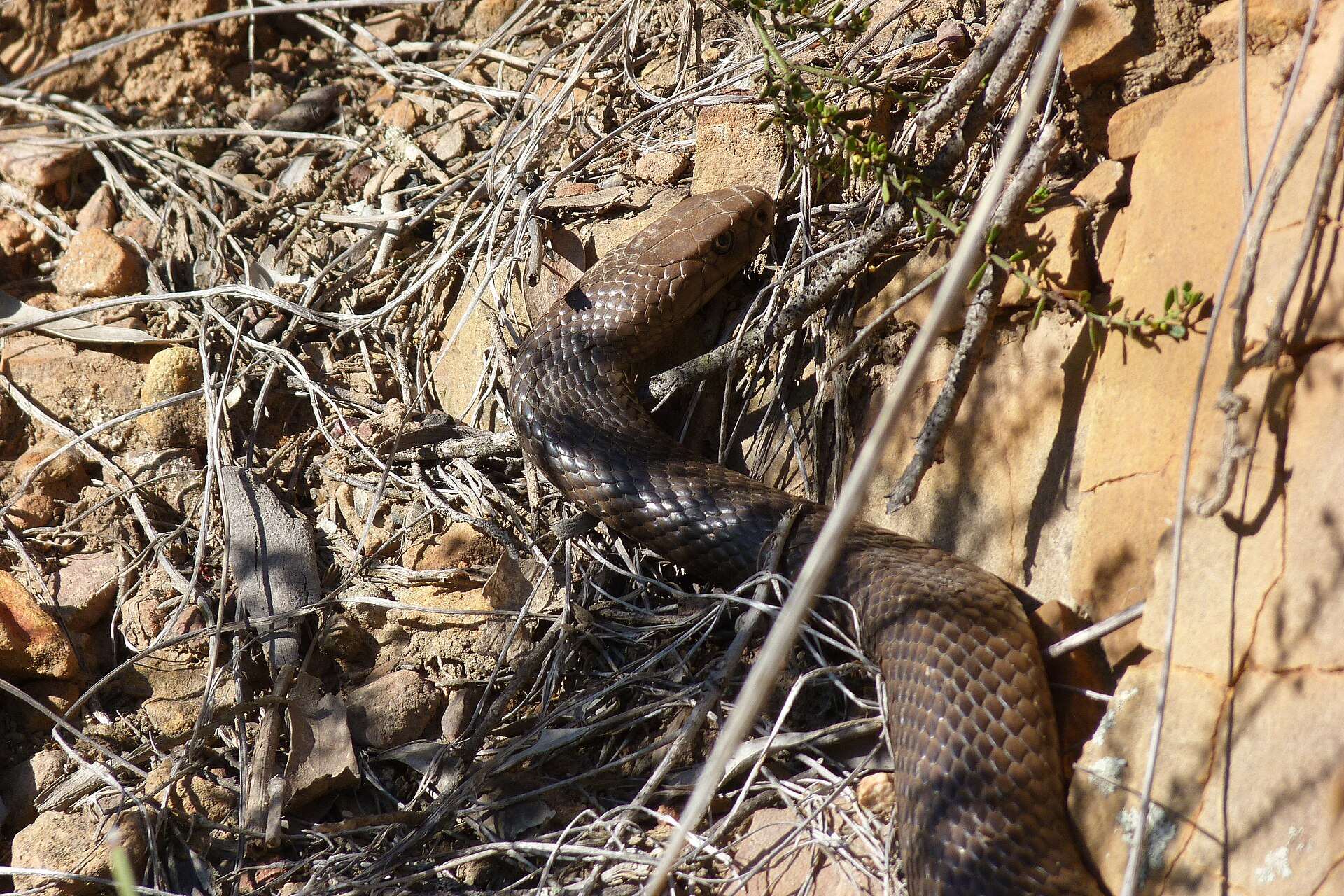
A slender, plain brown snake of eastern Australia, from pale tan to almost black, with a small head and a pale belly blotched with orange. It is common on farmland and at the edges of towns.

Is it dangerous?
Yes. It causes more snakebite deaths than any other Australian snake, and a bite can be painless at first. Anyone bitten should go to hospital immediately.
Do not approach. If someone is bitten, go to a hospital now.
At a glance
- Length
- 1.5–2.01 m
- Active
- By day
- Found in
- Eastern Australia and New Guinea
- Venom
- Neurotoxic and haemotoxic
- Young
- Lays eggs
- Habitat
- Woodland, Scrubland, Grassland
- Diet
- Rats and mice, Frogs, Lizards
- Lifespan
- At least 7 years in captivity
Length shows a typical adult, then the largest recorded.
IUCN Red List status: Least Concern
Country guideSnakes of Australia
True size
Common death adderMedically significant
1 m at most
About two thirds of the height of a 1.7 m adult.
Usual range 0.5–1.0 m, the bar on the ruler.
Common tree snakeNon-venomous
2 m at most
About 1 times the height of a 1.7 m adult.
Usual range 1.2–2.0 m, the bar on the ruler.
Eastern brown snakeMedically significant
2.01 m at most
About 1 times the height of a 1.7 m adult.
Usual range 1.5–2.01 m, the bar on the ruler.
Tiger snakeMedically significant
2.4 m at most
About 1.5 times the height of a 1.7 m adult.
Usual range 1.2–2.4 m, the bar on the ruler.
Inland taipanMedically significant
2.5 m at most
About 1.5 times the height of a 1.7 m adult.
Usual range 2.0–2.5 m, the bar on the ruler.
Red-bellied black snakeMedically significant
2.5 m at most
About 1.5 times the height of a 1.7 m adult.
Usual range 1.5–2.5 m, the bar on the ruler.
Coastal taipanMedically significant
2.9 m at most
About 1.5 times the height of a 1.7 m adult.
Usual range 2.0–2.9 m, the bar on the ruler.
Carpet pythonNon-venomous
4 m at most
About 2.5 times the height of a 1.7 m adult.
Usual range 2.0–4.0 m, the bar on the ruler.
Each snake is drawn at the longest length in its profile, on the same scale as the adult. Length is to scale; thickness is not.
Identification
The eastern brown snake is a medium-sized snake with a slender to moderate build and a smallish head that is barely wider than its neck1. Adults can be almost any shade of brown, from light tan, chestnut or burnt orange to nearly black, and the back is usually plain1. The belly is cream, yellow or orange with pinkish-orange, brown or grey blotches, and the smooth, slightly glossy scales lie in 17 rows at midbody1. The eye has an orange iris ringed with black, a round pupil and an obvious brow ridge1. Hatchlings have a dark patch on the head and nape, and some are banded along the whole body; these markings usually fade with age, although some populations keep the bands as adults1.
Adults average about 1.5 m long, and the largest specimen reliably measured was 2.01 m1.
Distribution
The eastern brown snake is widespread in eastern Australia, from northern Queensland to South Australia, with isolated populations in central and western parts of the Northern Territory1. The Reptile Database records it from New South Wales, Victoria, Queensland, South Australia, the Northern Territory and Western Australia, and from Papua New Guinea2. Brown snakes of this species group also live in southern and eastern New Guinea1. These were once thought to have been brought there by people, but genetic evidence suggests they arrived naturally from northern Queensland and Arnhem Land during the Pleistocene1.
Habitat
This snake lives in a wide range of habitats but avoids rainforest and alpine areas, preferring open country such as woodland, scrubland and savannah grassland1. In the arid inland it is found along watercourses and swampy areas that flood at least seasonally1. It can be especially common on farmland and is often met on the edges of towns and cities1. When inactive it shelters under logs and rocks, in deep soil cracks and animal burrows, and readily uses sheets of iron and building materials1.
Behaviour
The eastern brown snake is active mainly by day, although in very hot weather it may hunt in the late afternoon or early evening1. It can be out on mild winter days and has been seen basking at air temperatures as low as 14 °C1. It is alert and nervous: approached from a distance it usually flees or keeps still, but if surprised or cornered it puts on a threat display1. In this display it spreads its neck sideways and may lift the front of its body into an S-shaped coil with the mouth slightly open, and this neck-spreading comes before most bites1. Many bites have happened when people tried to kill the snake1.
Diet
It eats a wide range of vertebrates, including frogs, reptiles and their eggs, birds and mammals, especially introduced rats and mice1. Smaller snakes eat proportionally more lizards, while larger ones take more warm-blooded prey1. It hunts actively, searching likely hiding places with its good eyesight, and subdues prey with both venom and constriction1. Land clearing for farming brought plentiful rodents, and the species’ numbers have grown as a result1.
Reproduction
The eastern brown snake lays eggs2. Breeding begins in mid to late spring, when males wrestle in ritual combat for access to females1. Females lay up to 25 eggs, 15 on average, and may lay several clutches in a good season1. The eggs take from 36 days at 30 °C to 95 days at 25 °C to hatch, and communal nests have been found, including one in an abandoned rabbit warren1. Eastern brown snakes have lived for 7 years in captivity and probably live for at least a decade1.
Venom and medical significance
The World Health Organization places the eastern brown snake in its highest category of medical importance in Australia, and a specific brown snake antivenom has been made there since 19563,5. Its fangs are only about 3 mm long and a bite may be painless, yet it causes more snakebite deaths than any other Australian snake1. Its venom contains powerful nerve toxins and clotting toxins, as well as toxins that affect the heart and kidneys, and deaths have occurred from bleeding into the brain1. In a study of 136 people envenomed by brown snakes in Australia, all lost the ability to clot their blood normally, and over a third had serious complications such as collapse, kidney injury from damaged small blood vessels, major bleeding or cardiac arrest3. From 2005 to 2015, brown snakes caused 41% of confirmed envenomings and 17 of the 23 snakebite deaths recorded by the Australian Snakebite Project4. Anyone bitten should go to hospital immediately.
Conservation
The eastern brown snake is listed as Least Concern on the IUCN Red List, based on an assessment published in 20186. It readily lives in areas disturbed by people and feeds on abundant introduced house mice, so the Australian Museum considers its future assured1. Many are still killed on roads or by landowners, and snakes that eat cane toads die quickly from the toads’ poison1. In New South Wales, all native reptiles are protected under the Biodiversity Conservation Act 20169.
Similar species
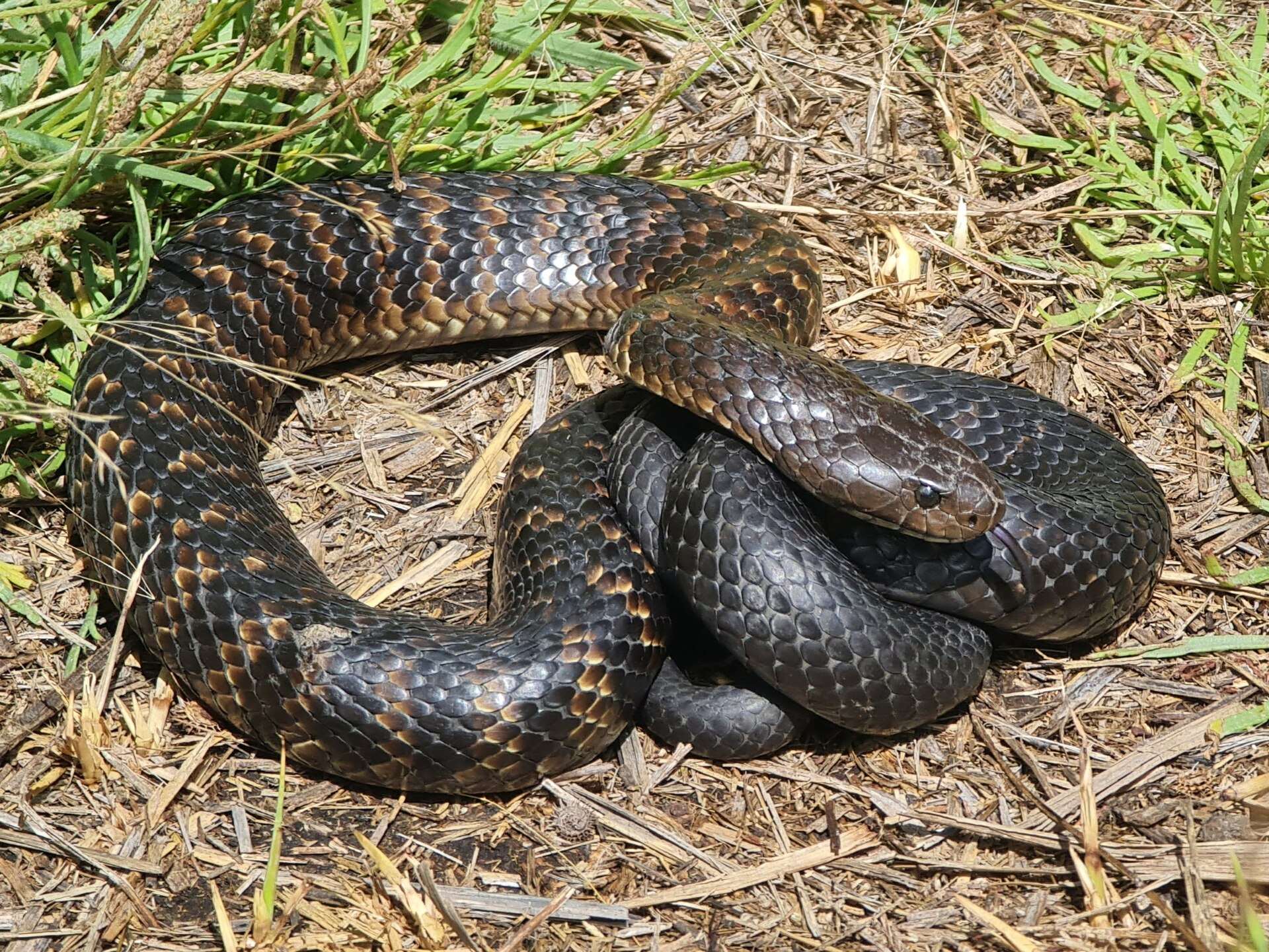
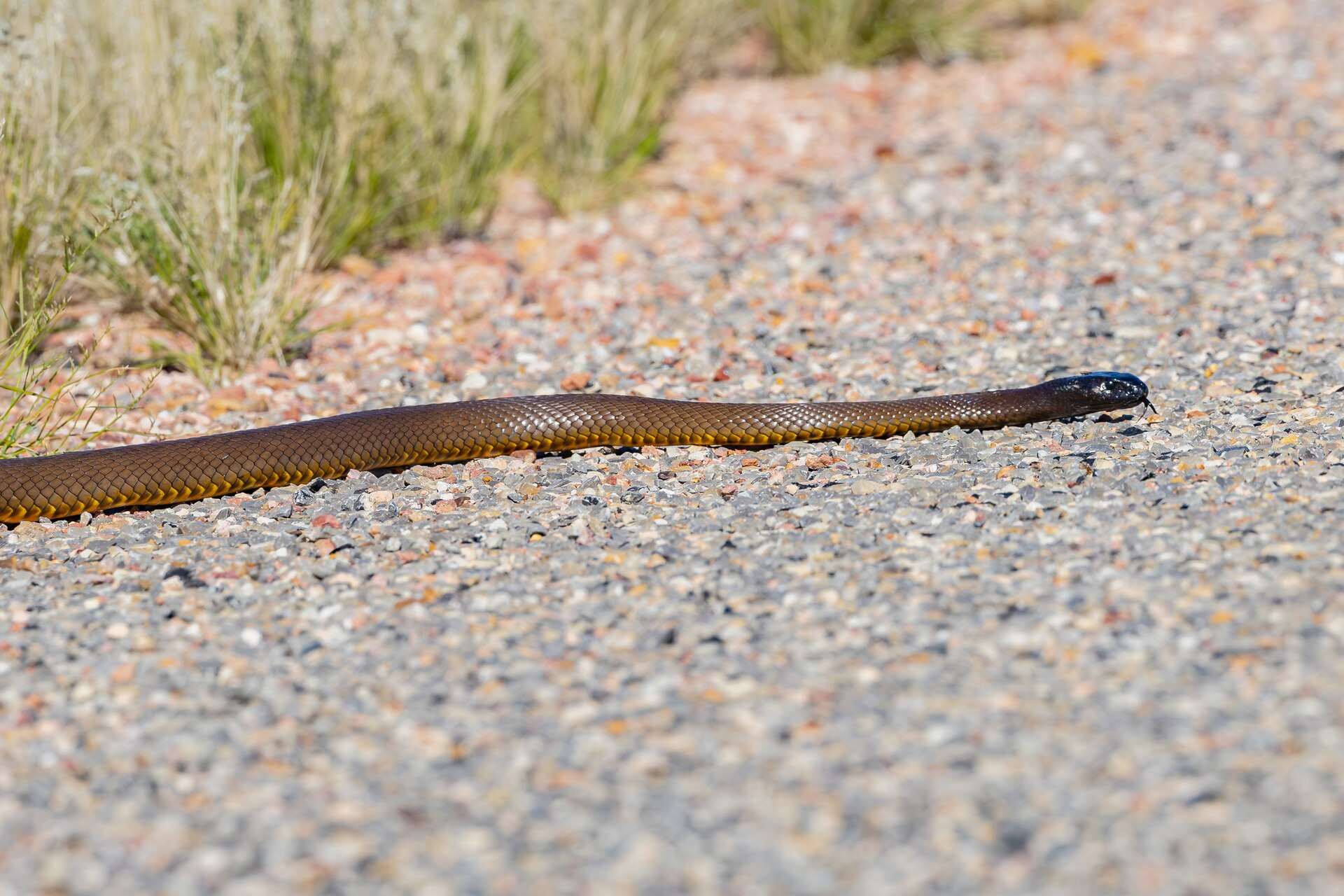
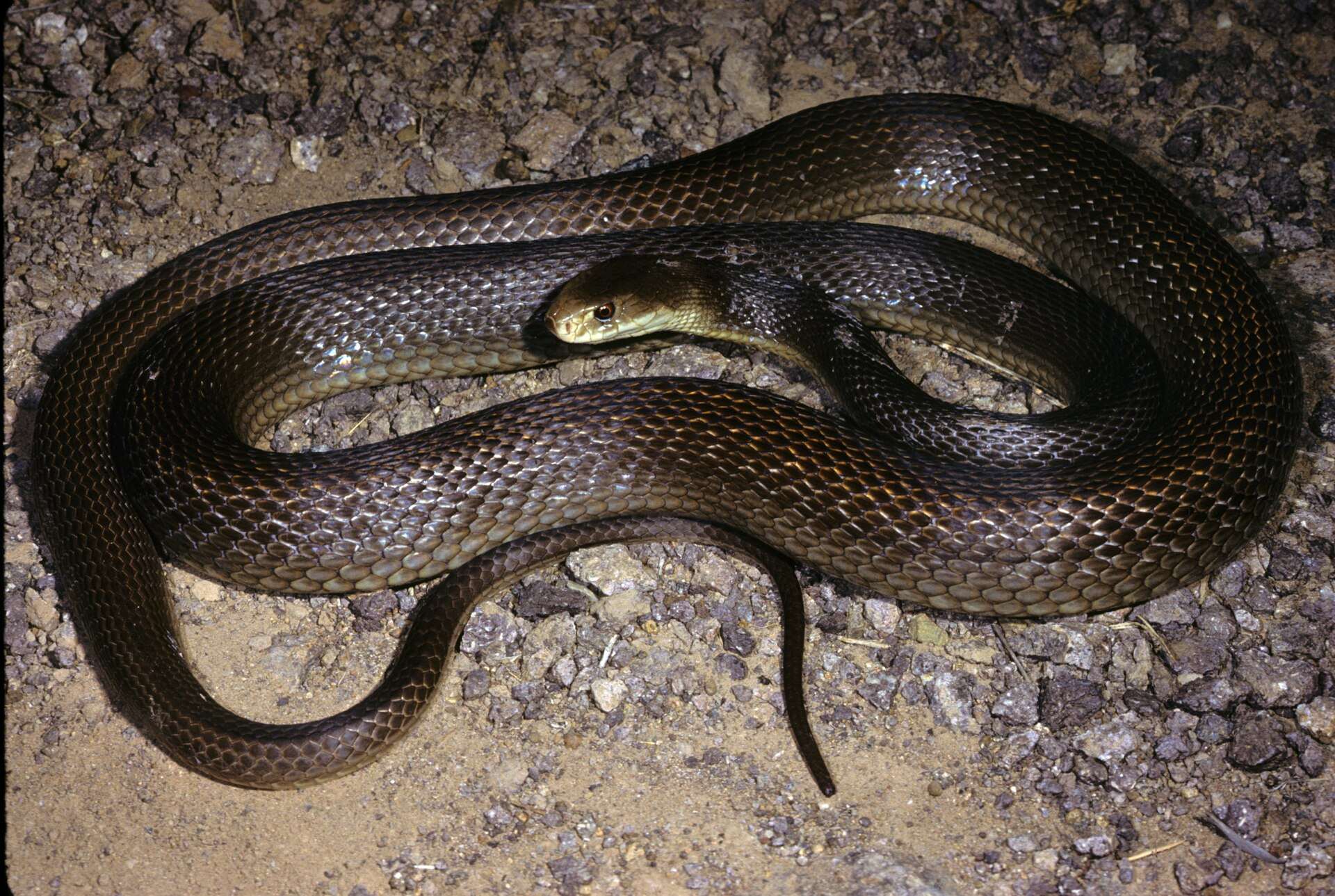
The eastern brown snake is easily confused with other brown snakes (Pseudonaja), and close inspection is usually needed to tell them apart1. It has a flesh-pink mouth, while the speckled, western and northern brown snakes have a mostly black mouth, and its blotched belly separates it from the peninsula brown snake, whose belly is entirely dark1. The coastal taipan (Oxyuranus scutellatus) usually has a pale face and snout, a large head and a slender neck, whereas a brown snake’s snout is the same colour as its body or darker and its head is barely wider than its neck7. Banded eastern brown snakes can also be mistaken for tiger snakes (Notechis scutatus)8. These differences are not a safe basis for handling any snake. Keep your distance from every snake you cannot identify.
In captivity
The eastern brown snake is dangerously venomous and is not suitable as a pet. In New South Wales, keeping venomous native reptiles requires an advanced reptile keeper licence and references confirming experience in handling them10. Captive eastern brown snakes may eat each other, especially when crowded; one 165 cm snake swallowed a 150 cm cagemate1.
Look-alikes
Don’t confuse it with…
These snakes are often mistaken for each other. Use the differences to learn, never as a reason to handle a snake.
References
- 1
Beatson, C. (2026). Eastern Brown Snake. Australian Museum. australian.museum
- 2
Uetz, P. et al. (eds.) (2026). Pseudonaja textilis (Duméril, Bibron & Duméril, 1854). The Reptile Database. reptile-database.reptarium.cz
- 3
Allen, G.E., Brown, S.G.A., Buckley, N.A., O'Leary, M.A., Page, C.B., Currie, B.J., White, J. & Isbister, G.K. (2012). Clinical effects and antivenom dosing in brown snake (Pseudonaja spp.) envenoming — Australian Snakebite Project (ASP-14). PLoS ONE 7(12): e53188. doi.org
- 4
Johnston, C.I., Ryan, N.M., Page, C.B., Buckley, N.A., Brown, S.G., O'Leary, M.A. & Isbister, G.K. (2017). The Australian Snakebite Project, 2005–2015 (ASP-20). Medical Journal of Australia 207(3): 119–125. mja.com.au
- 5
World Health Organization (2017). Guidelines for the production, control and regulation of snake antivenom immunoglobulins. WHO Technical Report Series No. 1004, Annex 5, Appendix 1: Worldwide distribution of medically important venomous snakes. cdn.who.int
- 6
Tallowin, O., O'Shea, M., Parker, F., Greenlees, M. & Shea, G. (2018). Pseudonaja textilis. The IUCN Red List of Threatened Species 2018: e.T42493315A42493324. iucnredlist.org
- 7
Beatson, C. (2026). Coastal Taipan. Australian Museum. australian.museum
- 8
Beatson, C. (2026). Tiger Snake. Australian Museum. australian.museum
- 9
NSW Government, Environment and Heritage (2024). Snakes. environment.nsw.gov.au
- 10
NSW Government, Environment and Heritage (2026). Reptile keeper licences. environment.nsw.gov.au
Play
Play as the eastern brown snake.
Its real pattern is a skin in Snake. Every run ends with a fact.