
Common death adder
Acanthophis antarcticus (Shaw, 1802)
Also called Southern death adder
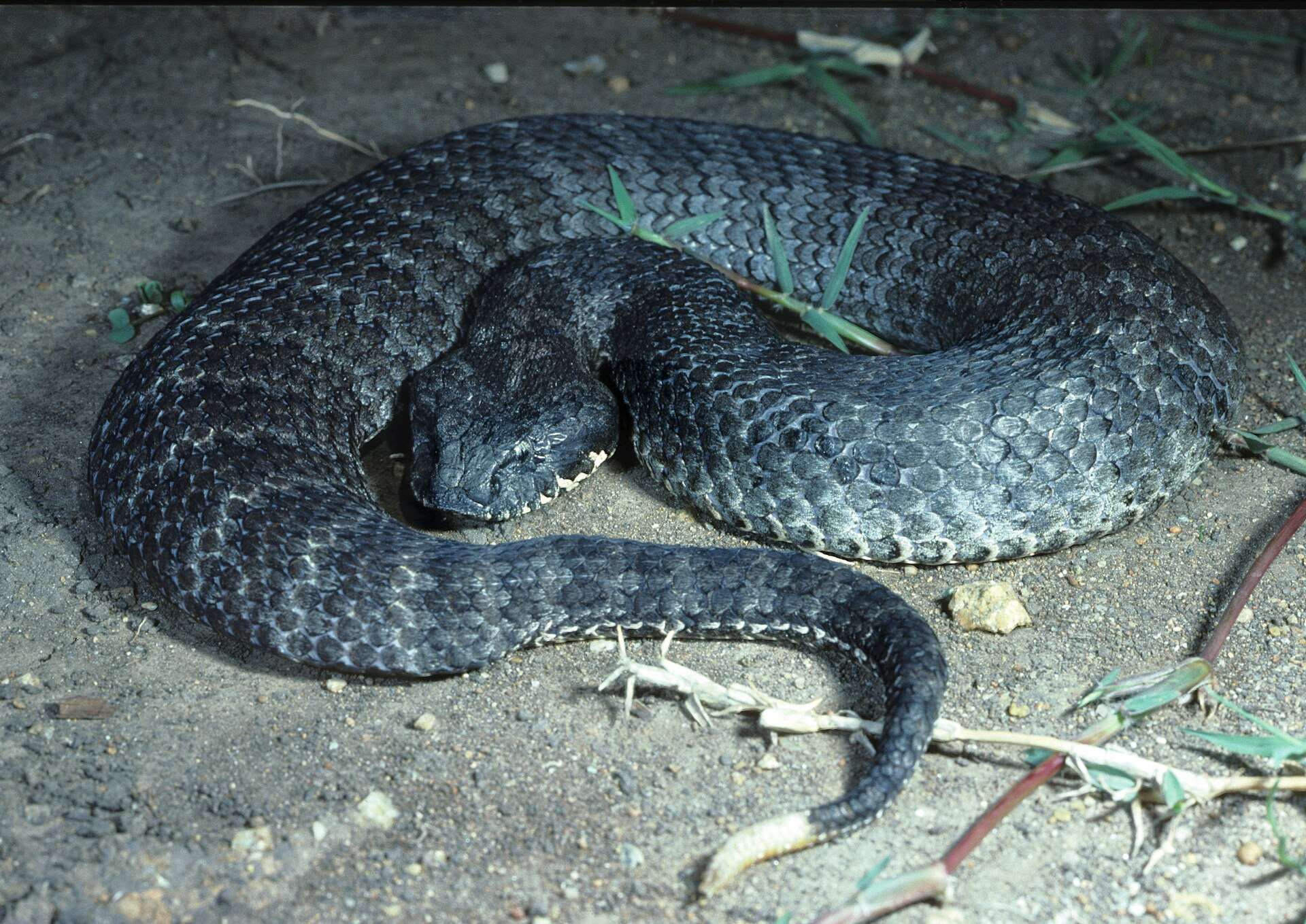
A short, thick-bodied snake with a broad triangular head and a thin tail ending in a pale or dark tip, grey to reddish-brown with dark bands. It lies hidden in leaf litter in forest, woodland and heath.

Is it dangerous?
Yes. Its venom can cause paralysis that may affect breathing, and it lies hidden where people can step on it. Anyone bitten should go to hospital immediately.
Do not approach. If someone is bitten, go to a hospital now.
At a glance
- Length
- 0.5–1.0 m
- Active
- At night
- Found in
- Eastern and southern Australia
- Venom
- Neurotoxic
- Young
- Live young
- Habitat
- Rainforest, Forest and woodland, Shrubland
- Diet
- Lizards, Frogs, Small mammals
Length shows a typical adult, then the largest recorded.
IUCN Red List status: Least Concern
Country guideSnakes of Australia
True size
Common death adderMedically significant
1 m at most
About two thirds of the height of a 1.7 m adult.
Usual range 0.5–1.0 m, the bar on the ruler.
Common tree snakeNon-venomous
2 m at most
About 1 times the height of a 1.7 m adult.
Usual range 1.2–2.0 m, the bar on the ruler.
Eastern brown snakeMedically significant
2.01 m at most
About 1 times the height of a 1.7 m adult.
Usual range 1.5–2.01 m, the bar on the ruler.
Tiger snakeMedically significant
2.4 m at most
About 1.5 times the height of a 1.7 m adult.
Usual range 1.2–2.4 m, the bar on the ruler.
Inland taipanMedically significant
2.5 m at most
About 1.5 times the height of a 1.7 m adult.
Usual range 2.0–2.5 m, the bar on the ruler.
Red-bellied black snakeMedically significant
2.5 m at most
About 1.5 times the height of a 1.7 m adult.
Usual range 1.5–2.5 m, the bar on the ruler.
Coastal taipanMedically significant
2.9 m at most
About 1.5 times the height of a 1.7 m adult.
Usual range 2.0–2.9 m, the bar on the ruler.
Carpet pythonNon-venomous
4 m at most
About 2.5 times the height of a 1.7 m adult.
Usual range 2.0–4.0 m, the bar on the ruler.
Each snake is drawn at the longest length in its profile, on the same scale as the adult. Length is to scale; thickness is not.
Identification
The common death adder has a broad, triangular head, a narrow neck, a short, thick body and a thin tail that ends in a soft, curved tip1,2. Its colour ranges from grey to rich reddish-brown, usually with irregular dark crossbands and dark bars on the lips2. The belly is whitish with black or brown flecks, the tail tip is cream or black, and the small eyes have a vertical pupil2. Snakes from south-eastern Australia are especially wide-bodied, with relatively larger heads than other death adders4. Adult males average about 44 cm and females about 58 cm, and the largest reach about 1 m1,2.
Distribution
The common death adder occurs from central Queensland through New South Wales to the southern parts of South Australia and Western Australia2. The Reptile Database lists it from Queensland, New South Wales, Victoria, South Australia and Western Australia, and also from Papua New Guinea3. It notes that the genus urgently needs revision and that several undescribed species probably exist, especially in New Guinea3. Two New Guinea forms once treated as subspecies of this snake, Acanthophis laevis and A. rugosus, are now recognised as separate species3.
Habitat
This snake lives in a wide variety of well-drained habitats, including rainforest and wet sclerophyll forest, woodland, shrubland, grassland and coastal heath1,2. It prefers sites with deep, settled leaf litter2. It spends much of its time lying concealed under loose sand, leaf litter or low plants2.
Behaviour
The common death adder is a sedentary, ground-dwelling snake2. It may be active by day, but it is most often found at night, when it moves between shelter sites2. Unlike most Australian venomous snakes, it does not search for food but waits in ambush with its body coiled and its tail tip near its head1,2. It lures prey by wriggling the tip of its tail like a worm or caterpillar while it lies hidden and coiled, then strikes quickly1,2. If threatened, it flattens its whole body into a rigid, curved coil and makes short, rapid strikes2.
Diet
The common death adder eats frogs, lizards, birds and small mammals1,2. Its diet changes with age: young snakes eat mainly lizards and frogs, while adults take more mammals and birds2. A study of more than 750 museum specimens found that death adders as a group eat mostly lizards, and that mammals are common prey of the common death adder in south-eastern Australia4. After striking, it injects its venom and waits for the prey to die before eating it1.
Reproduction
The common death adder gives birth to live young1,4. Mating usually takes place in spring, but females breed only every second year, and the young are typically born in February or March2. Litters contain between 2 and 42 young2. Males mature at about 24 months and females at about 42 months2. Female death adders grow about 20% longer than males, and male combat has never been reported in the genus4.
Venom and medical significance
The common death adder has relatively large fangs and toxic venom, and before antivenom was introduced about 60% of bites to people were fatal1. The World Health Organization lists it in Category 2 in Australia, which covers highly venomous snakes that are less often involved in bites or less well studied7. In an Australian study of 29 death adder bites involving several species, 12 of the 14 envenomed patients developed paralysis, such as drooping eyelids, double vision and difficulty swallowing, and two needed a machine to help them breathe5. Death adder bites do not cause the clotting problems seen with many other Australian snakes5,6. Death adder antivenom binds the venom in the blood, but in that study it did not reverse paralysis that had already started, and the weakness took a median of 21 hours to resolve5. Anyone bitten should go to hospital immediately.
Conservation
The common death adder is listed as Least Concern on the IUCN Red List, based on an assessment published in 20188. In Queensland it is listed as Vulnerable under the state’s Nature Conservation Act 19922. Known threats include being killed on roads and being poisoned after trying to eat introduced cane toads2. Suspected threats include land clearing, unsuitable fire regimes, trampling by livestock, predation by feral cats, foxes and pigs, and deliberate killing2.
Similar species
With its viper-like shape, a death adder is easy to tell apart from most other Australian snakes5. Several other death adder species live in Australia, but the common death adder is the only one in the Sydney region1. Desert death adders, such as Acanthophis pyrrhus and A. wellsi, are much more slender than the heavy-bodied southern common death adder4. These differences are not a safe basis for handling any snake. Keep your distance from every snake you cannot identify.
In captivity
The common death adder is dangerously venomous and is not suitable as a pet. In an Australian study of death adder bites, 15 of the 29 patients were snake handlers, and two handlers who had been bitten before had allergic reactions to the venom5. In New South Wales, keeping venomous native reptiles requires an advanced reptile keeper licence and references confirming experience in handling them9.
References
- 1
Mahony, S. (2026). Common Death Adder. Australian Museum. australian.museum
- 2
Queensland Government, Department of the Environment, Tourism, Science and Innovation. Common death adder (Acanthophis antarcticus): species profile. WildNet. apps.des.qld.gov.au
- 3
Uetz, P. et al. (eds.) (2026). Acanthophis antarcticus (Shaw, 1802). The Reptile Database. reptile-database.reptarium.cz
- 4
Shine, R., Spencer, C.L. & Keogh, J.S. (2014). Morphology, reproduction and diet in Australian and Papuan death adders (Acanthophis, Elapidae). PLoS ONE 9(4): e94216. doi.org
- 5
Johnston, C.I., O'Leary, M.A., Brown, S.G.A., Currie, B.J., Halkidis, L., Whitaker, R., Close, B. & Isbister, G.K. (2012). Death adder envenoming causes neurotoxicity not reversed by antivenom — Australian Snakebite Project (ASP-16). PLoS Neglected Tropical Diseases 6(9): e1841. doi.org
- 6
Isbister, G.K., Brown, S.G.A., Page, C.B., McCoubrie, D.L., Greene, S.L. & Buckley, N.A. (2013). Snakebite in Australia: a practical approach to diagnosis and treatment. Medical Journal of Australia 199(11): 763–768. mja.com.au
- 7
World Health Organization (2017). Guidelines for the production, control and regulation of snake antivenom immunoglobulins. WHO Technical Report Series No. 1004, Annex 5, Appendix 1: Worldwide distribution of medically important venomous snakes. cdn.who.int
- 8
Hobson, R., Venz, M., Sanderson, C., Greenlees, M. & Dickman, C. (2018). Acanthophis antarcticus. The IUCN Red List of Threatened Species 2018: e.T42492756A42492764. iucnredlist.org
- 9
NSW Government, Environment and Heritage (2026). Reptile keeper licences. environment.nsw.gov.au
Play
Play as the common death adder.
Its real pattern is a skin in Snake. Every run ends with a fact.