
Carpet python
Morelia spilota (Lacépède, 1804)
Also called Diamond python, Carpet snake
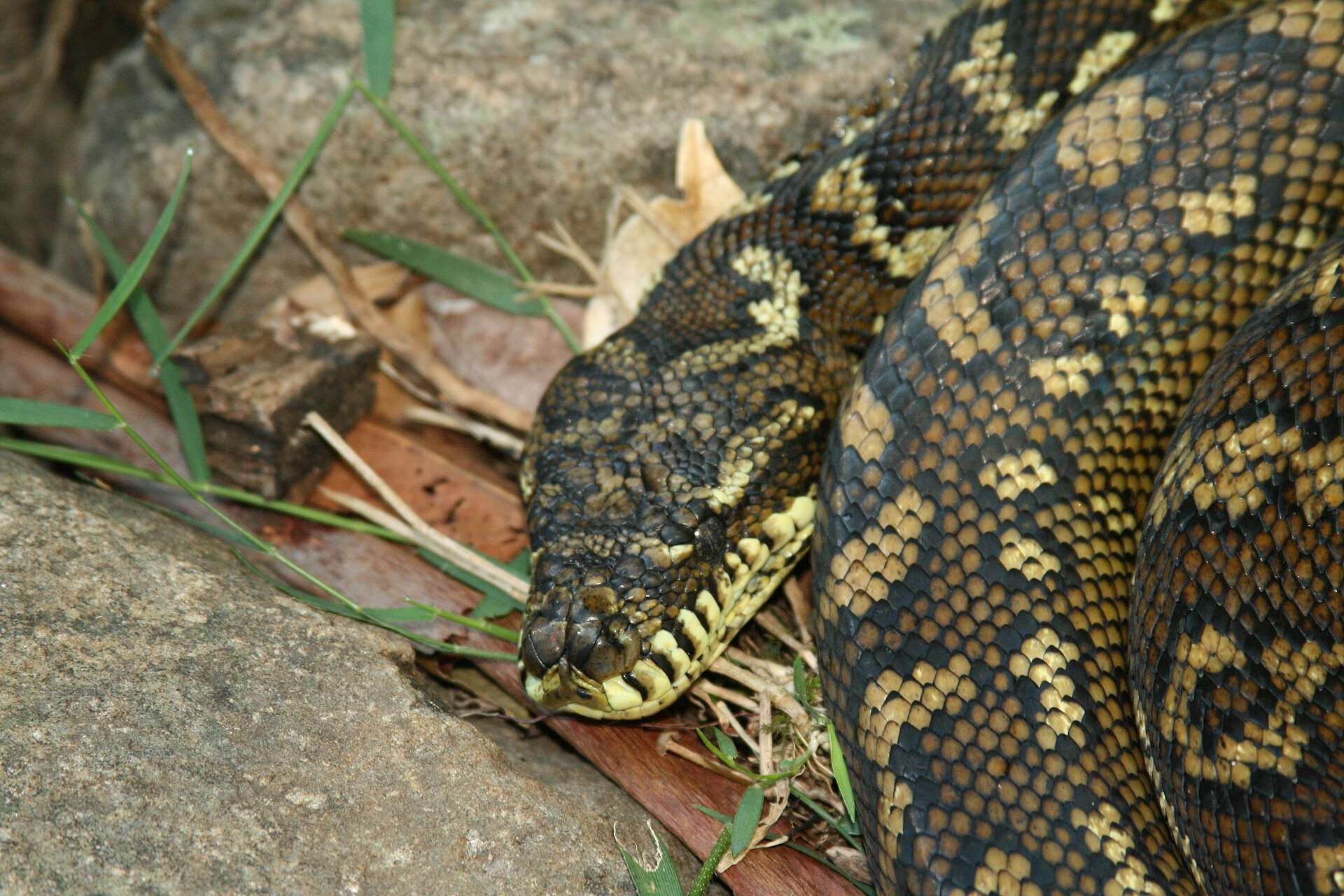
Australia's most familiar python: a large snake with olive to brown skin and cream blotches. It lives from rainforest to inland country and often shelters in trees and house roofs.

Is it dangerous?
No. It has no venom, but a large python can give a painful bite, and its teeth can break off in the wound. Leave it alone.
Harmless to people, but it may bite if handled. Treat any snake you can’t identify as venomous.
Snakebite first aidAt a glance
- Length
- 2.0–4.0 m
- Weight
- Up to about 11 kg
- Active
- At night
- Found in
- Australia and New Guinea
- Venom
- None
- Young
- Lays eggs
- Habitat
- Rainforest, Eucalypt forest and woodland, Semi-arid inland country
- Diet
- Rats and mice, Possums, Birds
- Lifespan
- Up to 20–30 years in captivity
Length shows a typical adult, then the largest recorded.
IUCN Red List status: Least Concern
Country guideSnakes of AustraliaSnakes of Indonesia
True size
Common death adderMedically significant
1 m at most
About two thirds of the height of a 1.7 m adult.
Usual range 0.5–1.0 m, the bar on the ruler.
Common tree snakeNon-venomous
2 m at most
About 1 times the height of a 1.7 m adult.
Usual range 1.2–2.0 m, the bar on the ruler.
Eastern brown snakeMedically significant
2.01 m at most
About 1 times the height of a 1.7 m adult.
Usual range 1.5–2.01 m, the bar on the ruler.
Inland taipanMedically significant
2.5 m at most
About 1.5 times the height of a 1.7 m adult.
Usual range 2.0–2.5 m, the bar on the ruler.
Coastal taipanMedically significant
2.9 m at most
About 1.5 times the height of a 1.7 m adult.
Usual range 2.0–2.9 m, the bar on the ruler.
Carpet pythonNon-venomous
4 m at most
About 2.5 times the height of a 1.7 m adult.
Usual range 2.0–4.0 m, the bar on the ruler.
Burmese pythonNon-venomous
5.79 m at most
About 3.5 times the height of a 1.7 m adult.
Usual range 2.6–5.79 m, the bar on the ruler.
Reticulated pythonNon-venomous
7.67 m at most
About 4.5 times the height of a 1.7 m adult.
Usual range 2.5–7.67 m, the bar on the ruler.
Each snake is drawn at the longest length in its profile, on the same scale as the adult. Length is to scale; thickness is not.
Identification
The carpet python is a large, non-venomous snake with olive to brown skin marked with cream blotches, which camouflage it among leaf litter, tree hollows, logs and rocky crevices1. Its colours and patterns vary across its range; typical snakes are pale to dark brown with blackish or very dark brown blotches that form a regular pattern2. Like other pythons it has a bulky body and a roughly triangular head that is distinct from the neck2. It also has heat-sensitive pits on its lower jaw1.
Most adults are about 2 m long and few exceed 2.5 m, but some reach 4 m1,2. The largest can weigh about 11 kg, and adult males grow larger and heavier-bodied than females6.
Distribution
The carpet python lives in Australia and New Guinea3. In Australia it is found almost everywhere on the mainland, but not in the arid centre or in Tasmania1,3. In New Guinea it occurs along the southern coast of Papua New Guinea and into the Indonesian province of Papua, as far west as Merauke3.
The Reptile Database recognises several subspecies, including the diamond python of coastal New South Wales, the coastal carpet python from northern Cape York to northern New South Wales, the jungle carpet python of north-eastern Queensland, the inland or Murray-Darling carpet python and the north-western carpet python of northern Australia3. Two close relatives, the south-western carpet python (Morelia imbricata) and the Centralian python (Morelia bredli), were once treated as part of this species but are now listed as separate species3,4.
Habitat
Carpet pythons live in a very wide range of habitats, from the wet tropics to semi-arid inland country1,2. Coastal carpet pythons are found in rainforest, wet and dry eucalypt forest, heathland, pasture, farmland and towns, and they often rest in trees and the roofs of houses9. In the Brisbane area the carpet python is one of the snakes people meet most often10. In Victoria, the Murray-Darling carpet python lives in tree hollows and rock crevices along rivers and streams8.
Behaviour
Pythons are mostly active at night, travelling along the ground and through trees, but they are often found basking in the sun during the day, and diamond pythons may bask in trees2,5. They hunt by ambush, waiting for prey to pass, and their heat-sensitive pits let them sense and track the body warmth of other animals1. They are regularly found curled up in ceilings, where they find shelter and warmth and help control rats and possums2,5. In suburban south-east Queensland, carpet pythons were active and fed all year round, and adult males fought each other during the breeding season6. In Victoria’s cooler climate, the Murray-Darling carpet python can stay inactive for up to five months over winter8.
Diet
The carpet python is a constrictor: it coils around its prey and suffocates it, then swallows it whole1. It feeds mostly after dark on animals such as rats, possums and birds, while smaller pythons prefer lizards1. In a study of 258 “nuisance” pythons from Brisbane and Ipswich, most food came from domestic and commensal birds and mammals6. The prey changed with the snake’s size: medium-sized pythons ate mostly mice, rats and parrots, while the largest took cats, brushtail possums and poultry6.
Reproduction
The carpet python lays eggs1,3. In Queensland, a female lays up to 20 eggs at a time1. She coils around her eggs to protect them and keep them warm, a kind of care that is uncommon in snakes and ends once the young hatch5. Female pythons can even “shiver” to make heat for their eggs2. In Victoria, Murray-Darling carpet pythons breed only every three to four years, and their eggs hatch after 50–60 days8. The young look after themselves from the moment they hatch1.
Venom and medical significance
The carpet python has no venom; Queensland’s pythons lack both venom and fangs1,2. It can still give a painful bite, and its teeth can break off and stay in the wound5. Carpet pythons have a strong feeding response, a lightning-fast strike followed by throwing coils around the food, which can be mistaken for aggression, and a snake may occasionally mistake a person’s hand for food9.
Conservation
The carpet python is listed as Least Concern on the IUCN Red List (assessed in 2017)7. In Queensland it is also listed as Least Concern under the Nature Conservation Act 19921. Some populations are in trouble: the Murray-Darling carpet python is listed as endangered in Victoria, where only about 160 are thought to remain in the wild8. The diamond python is not as widespread in Sydney as it once was and is under pressure from habitat destruction, although it is not considered endangered5.
Similar species
The Centralian python and the south-western carpet python are close relatives that were long treated as forms of the carpet python3,4. Pythons in general have bulky bodies, triangular heads distinct from the neck, heat pits on the jaws and a pair of small spurs beside the vent2. Even so, Queensland’s wildlife agency warns that there is no hard-and-fast rule for telling a dangerous snake from a harmless one2. These differences are not a safe basis for handling any snake. Keep your distance from every snake you cannot identify.
In captivity
The carpet python is kept as a pet in Australia, and the coastal carpet python is probably the most common python kept there9. In captivity it can live for up to 20–30 years9. Keepers need a licence and must never take a python from the wild; in Queensland a pet snake can be bought, captive-bred, from an authorised reptile dealer, and the keeper also needs a wildlife licence2,9. Carpet pythons are solitary, so each one should be housed alone in an enclosure tall enough to climb, with a range of temperatures to choose from9.
References
- 1
Queensland Government, Department of the Environment, Tourism, Science and Innovation. Carpet python. environment.desi.qld.gov.au
- 2
Queensland Government, Department of the Environment, Tourism, Science and Innovation. Frequently asked questions about snakes. environment.desi.qld.gov.au
- 3
Uetz, P. et al. (eds.) (2026). Morelia spilota (Lacépède, 1804). The Reptile Database. reptile-database.reptarium.cz
- 4
Uetz, P. et al. (eds.) (2026). Morelia bredli (Gow, 1981). The Reptile Database. reptile-database.reptarium.cz
- 5
Australian Museum (2025). Diamond Python. australian.museum
- 6
Fearn, S., Robinson, B., Sambono, J. & Shine, R. (2001). Pythons in the pergola: the ecology of 'nuisance' carpet pythons (Morelia spilota) from suburban habitats in south-eastern Queensland. Wildlife Research 28(6): 573–579. doi.org
- 7
Tallowin, O., Parker, F., O'Shea, M., Vanderduys, E., Wilson, S., Shea, G. & Hobson, R. (2017). Morelia spilota. The IUCN Red List of Threatened Species 2017: e.T62232A21649539. iucnredlist.org
- 8
Conservation Regulator, Victorian Government (2024). Focus species: Murray-Darling carpet python (Morelia spilota metcalfei). Fact and activity sheet. vic.gov.au
- 9
Doneley, B. (2023). How should I care for my carpet python? RSPCA Australia Knowledgebase. kb.rspca.org.au
- 10
Queensland Government, Department of the Environment, Tourism, Science and Innovation. Snakes of South-East Queensland. environment.desi.qld.gov.au
Play
Play as the carpet python.
Its real pattern is a skin in Snake. Every run ends with a fact.