
Tiger snake
Notechis scutatus (Peters, 1861)
Also called Mainland tiger snake, Eastern tiger snake, Black tiger snake
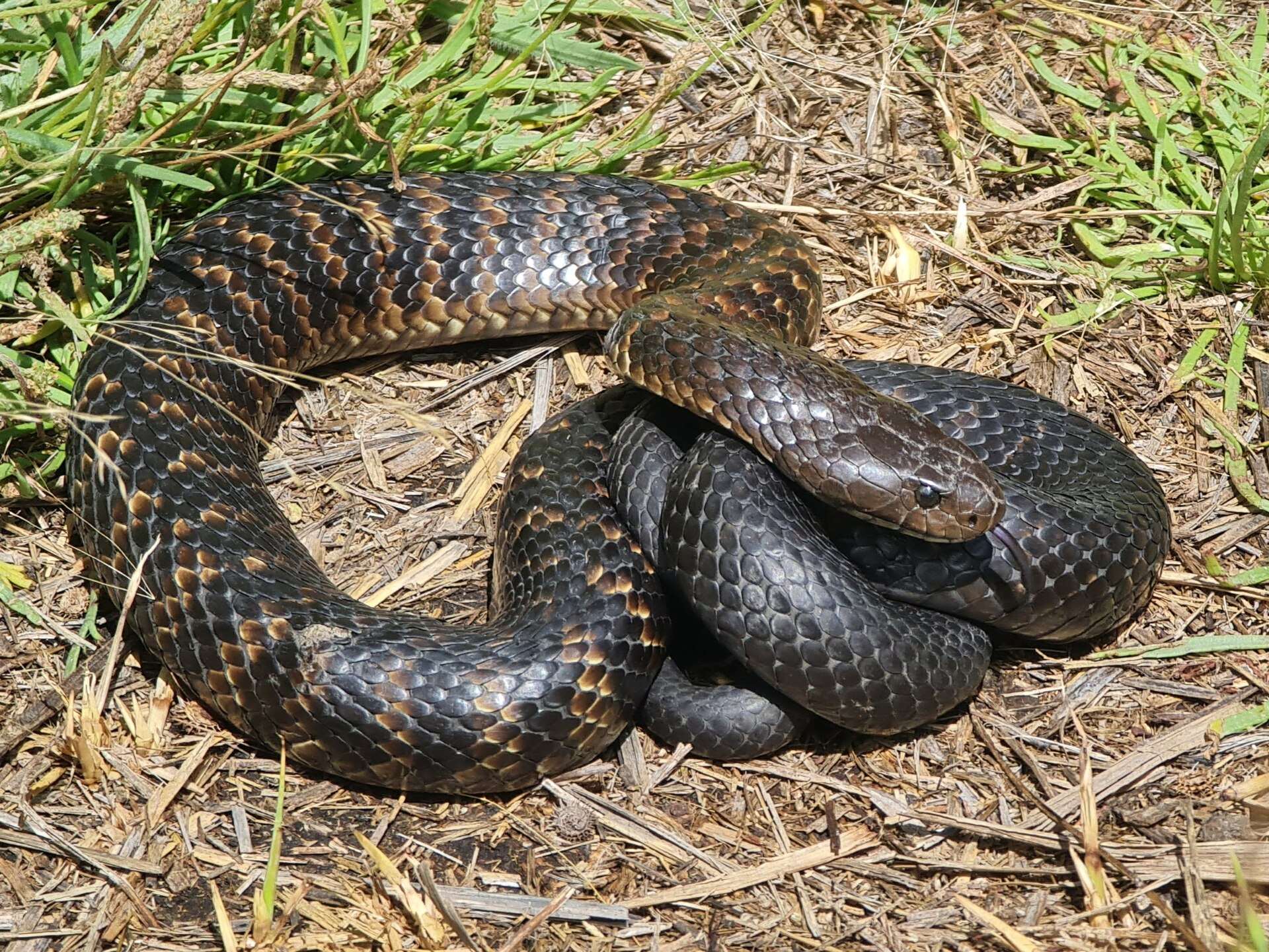
A heavy-bodied snake of southern Australia and Tasmania, often dark olive to black with pale yellowish crossbands, although some are plain. It is usually found near water, in wetlands, creeks and swamps.

Is it dangerous?
Yes. It is a leading cause of serious snakebite in southern Australia, and its venom can cause bleeding, paralysis and muscle damage. Get hospital care immediately.
Do not approach. If someone is bitten, go to a hospital now.
At a glance
- Length
- 1.2–2.4 m
- Active
- By day
- Found in
- Southern Australia and Tasmania
- Venom
- Neurotoxic, haemotoxic and myotoxic
- Young
- Live young
- Habitat
- Wetlands and swamps, Creeks and dams, Grassland
- Diet
- Frogs, Fish, Lizards
Length shows a typical adult, then the largest recorded.
IUCN Red List status: Least Concern
Country guideSnakes of Australia
True size
Common death adderMedically significant
1 m at most
About two thirds of the height of a 1.7 m adult.
Usual range 0.5–1.0 m, the bar on the ruler.
Eastern brown snakeMedically significant
2.01 m at most
About 1 times the height of a 1.7 m adult.
Usual range 1.5–2.01 m, the bar on the ruler.
Banded kraitMedically significant
2.25 m at most
About 1.5 times the height of a 1.7 m adult.
Usual range 1.35–2.25 m, the bar on the ruler.
Tiger snakeMedically significant
2.4 m at most
About 1.5 times the height of a 1.7 m adult.
Usual range 1.2–2.4 m, the bar on the ruler.
Red-bellied black snakeMedically significant
2.5 m at most
About 1.5 times the height of a 1.7 m adult.
Usual range 1.5–2.5 m, the bar on the ruler.
Inland taipanMedically significant
2.5 m at most
About 1.5 times the height of a 1.7 m adult.
Usual range 2.0–2.5 m, the bar on the ruler.
Coastal taipanMedically significant
2.9 m at most
About 1.5 times the height of a 1.7 m adult.
Usual range 2.0–2.9 m, the bar on the ruler.
Black mambaMedically significant
4.5 m at most
About 2.5 times the height of a 1.7 m adult.
Usual range 2.5–4.5 m, the bar on the ruler.
Each snake is drawn at the longest length in its profile, on the same scale as the adult. Length is to scale; thickness is not.
Identification
The tiger snake is a robust, muscular snake whose colour varies greatly between and within populations1,2. The best-known form is dark olive-brown to blackish with off-white to yellowish crossbands of varying width, but some individuals have no bands and range from yellowish-brown or sandy grey to jet black1,2. The belly is usually pale yellow, white or grey, and the broad, blunt head is only slightly wider than the neck1,2. When threatened it can flatten its neck and forebody, showing black skin between the large, smooth, semi-glossy scales1,3. Mainland adults average about 1.2 m long and can reach 2.1 m, while island populations range from about 1 m on Roxby Island to 2.4 m on Chappell Island in Bass Strait1. Males grow larger than females1,2.
Distribution
Tiger snakes are found only in Australia, in two separate regions: the south-east, including Tasmania and the Bass Strait islands, and the far south-west1,3. They also live on many offshore islands, from Carnac and Garden islands off Western Australia to Kangaroo Island and the islands of Bass Strait1. Their patchy range is the result of a drying climate and of rising seas that cut islands off from the mainland in the past 6,000–10,000 years1. The black tiger snake, once called Notechis ater, was merged into N. scutatus in 2005, and the island and regional forms are now treated as variants of one highly variable species1,3.
Habitat
Tiger snakes are often found near water, such as creeks, dams, drains, lagoons, wetlands and swamps1. They also live on grazing land and in other heavily changed areas where there is water and cover, and in Tasmania they occur in most habitats, from dry rocky areas to wet marshes1,2. They shelter under fallen timber, in thick matted vegetation and in old animal burrows1. They range from sea level to over 1,000 m in Tasmania1.
Behaviour
Tiger snakes are mostly active by day but will forage on warm evenings1. They are good climbers, recorded up to 10 m above the ground, and can stay underwater for at least 9 minutes1. In cool weather they retreat to burrows, under boulders or into dead trees, sometimes 1.2 m underground, and up to 26 young snakes have been found sharing one winter shelter1,2. They are normally timid and usually retreat when a person approaches2. If threatened, a tiger snake flattens its neck, raises its head and may make a mock strike with an explosive hiss, and like most snakes it will not bite unless provoked2.
Diet
Tiger snakes have a broad diet of frogs and tadpoles, fish, lizards, birds and mammals, and they also eat carrion1. They often raid birds’ nests and readily enter the burrows of mice, rats and rabbits2. Prey is quickly subdued by the venom, sometimes with the help of constriction1,2. On Chappell Island, where they feed on muttonbird chicks, tiger snakes grow up to 2.4 m long, while on Roxby Island, with no nesting seabirds, they reach only about 1 m1.
Reproduction
Tiger snakes give birth to live young1,3. At the start of the breeding season males fight, each trying to press down the other’s head, and in Tasmania mating can last up to seven hours1,2. In south-western Australia, litters of 10 to 64 young are born between late summer and mid-autumn, and a litter of 126 young has been recorded1,2. The newborn snakes are 21.5–27 cm long and receive no parental care, and females breed at most every second year2.
Venom and medical significance
The World Health Organization places the tiger snake in its highest category of medical importance in Australia6. Its venom mainly affects the nerves and blood clotting, and it can also break down muscle, which can lead to kidney failure1,2. In 56 confirmed tiger snake envenomings, nearly all patients lost the ability to clot their blood normally, 17 developed paralysis, 11 had muscle damage and three developed kidney failure4. From 2005 to 2015, tiger snakes caused 17% of confirmed envenomings recorded by the Australian Snakebite Project and four of the 23 deaths5. Tiger snake antivenom is used to treat these bites, and one vial appears to bind all the venom in the blood4. Anyone bitten should go to hospital immediately.
Conservation
The tiger snake is listed as Least Concern on the IUCN Red List, based on an assessment published in 20187. Some isolated populations have been listed as vulnerable, including the Flinders Ranges population and the Chappell Island population in Tasmania1. Some island populations could decline if muttonbird colonies are disturbed2. Tiger snakes are legally protected in Tasmania and New South Wales, but many are still killed deliberately or on roads1,2,8.
Similar species
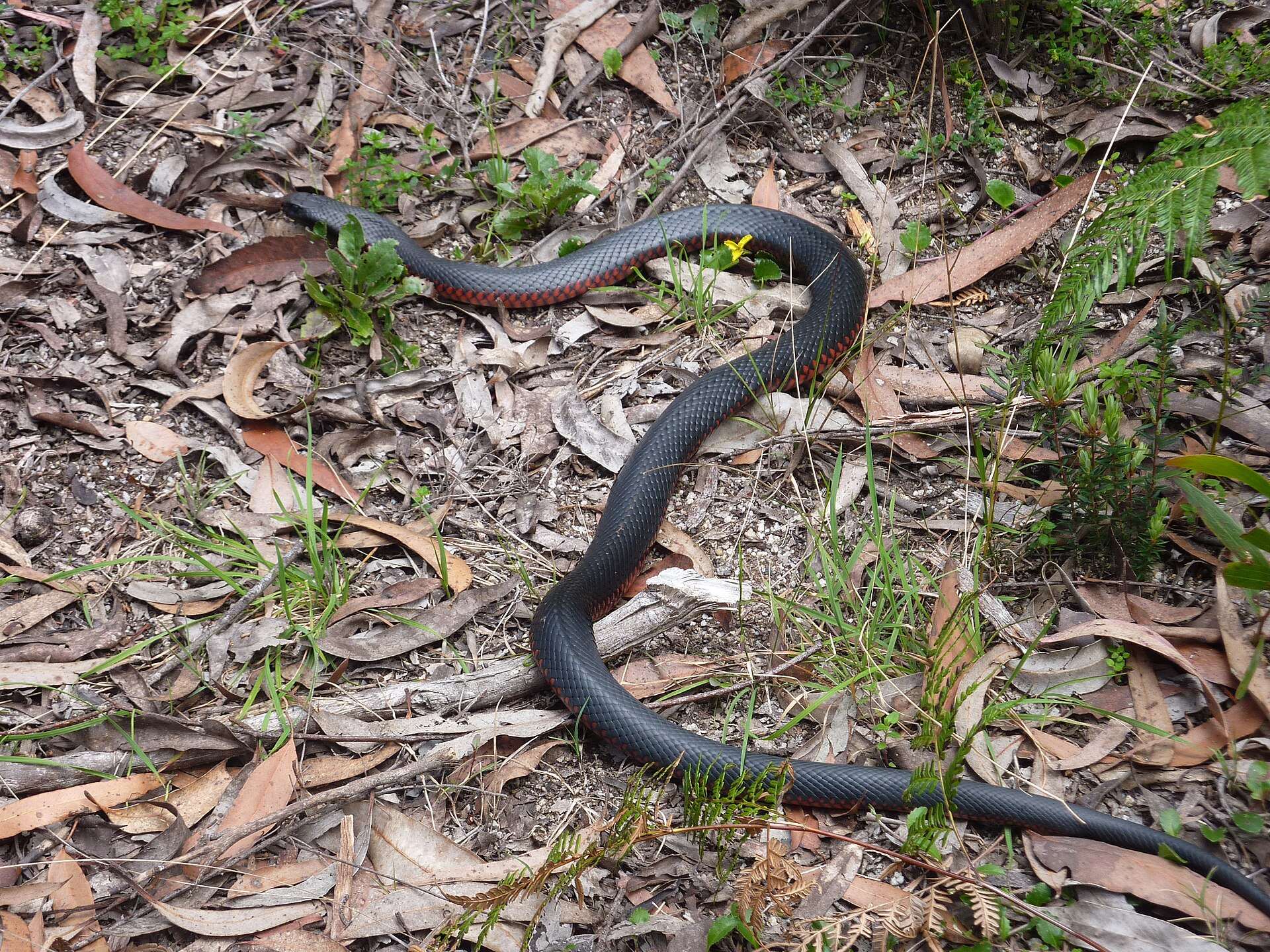
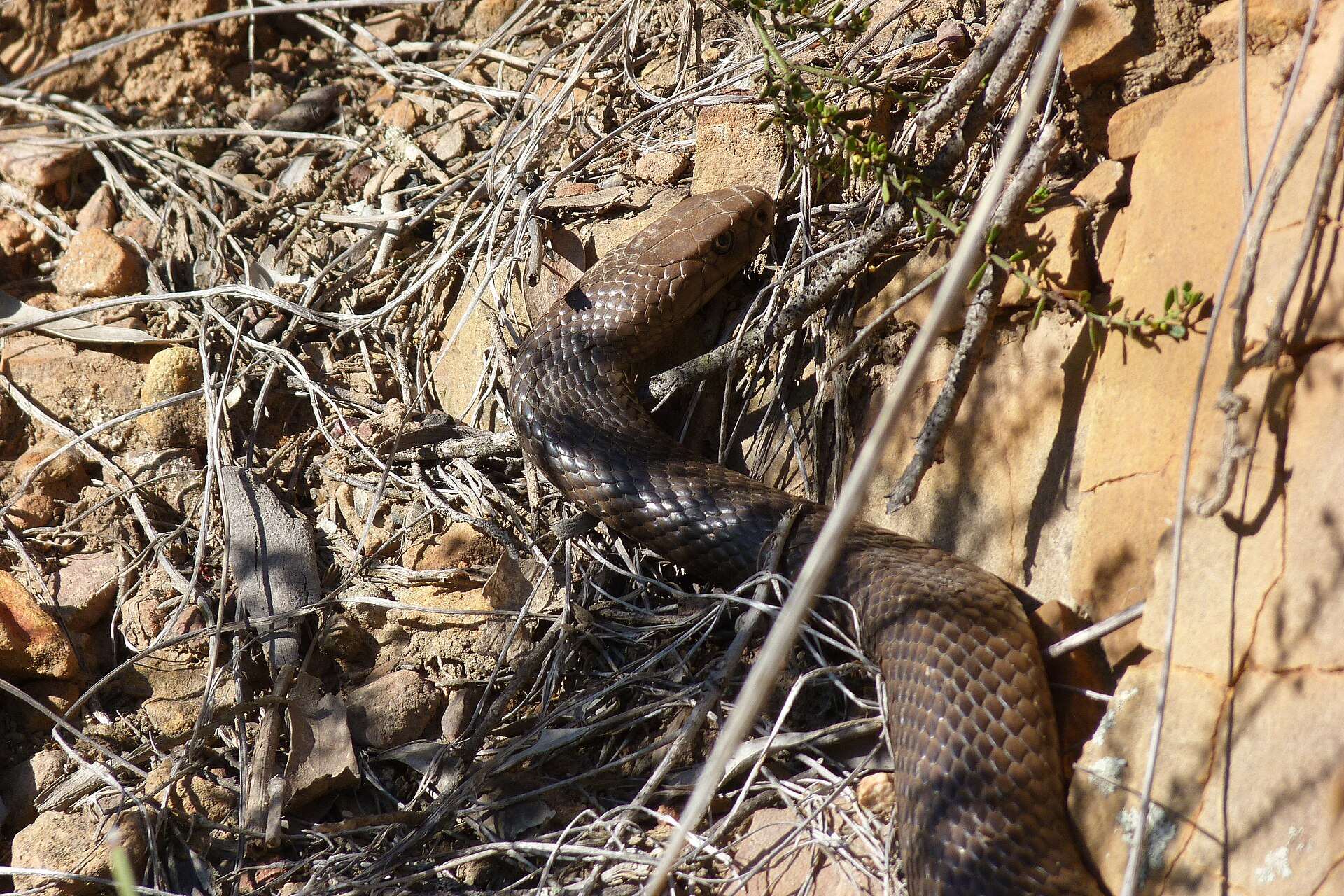
Large banded tiger snakes are fairly distinctive, but they can be confused with banded eastern brown snakes (Pseudonaja textilis), which have a divided anal scale and paired scales under the tail, whereas a tiger snake’s are single1,10. Unbanded tiger snakes can resemble copperheads (Austrelaps) and black snakes (Pseudechis), and in Tasmania tiger snakes and copperheads overlap in size, habitat and behaviour1,2. On Kangaroo Island some tiger snakes have reddish bellies and have been mistaken for red-bellied black snakes (Pseudechis porphyriacus)1. Young tiger snakes can look like rough-scaled snakes (Tropidechis carinatus) or Stephens’ banded snakes (Hoplocephalus stephensii)1. These differences are not a safe basis for handling any snake. Keep your distance from every snake you cannot identify.
In captivity
The tiger snake is dangerously venomous and is not suitable as a pet. In New South Wales, all native reptiles are protected, and keeping venomous species requires an advanced reptile keeper licence and references confirming experience in handling them8,9.
Look-alikes
Don’t confuse it with…
These snakes are often mistaken for each other. Use the differences to learn, never as a reason to handle a snake.
References
- 1
Beatson, C. (2026). Tiger Snake. Australian Museum. australian.museum
- 2
Department of Natural Resources and Environment Tasmania (2018). Tiger Snake. nre.tas.gov.au
- 3
Uetz, P. et al. (eds.) (2026). Notechis scutatus (Peters, 1861). The Reptile Database. reptile-database.reptarium.cz
- 4
Isbister, G.K., O'Leary, M.A., Elliott, M. & Brown, S.G.A. (2012). Tiger snake (Notechis spp) envenoming: Australian Snakebite Project (ASP-13). Medical Journal of Australia 197(3): 173–177. (Abstract, PubMed) pubmed.ncbi.nlm.nih.gov
- 5
Johnston, C.I., Ryan, N.M., Page, C.B., Buckley, N.A., Brown, S.G., O'Leary, M.A. & Isbister, G.K. (2017). The Australian Snakebite Project, 2005–2015 (ASP-20). Medical Journal of Australia 207(3): 119–125. mja.com.au
- 6
World Health Organization (2017). Guidelines for the production, control and regulation of snake antivenom immunoglobulins. WHO Technical Report Series No. 1004, Annex 5, Appendix 1: Worldwide distribution of medically important venomous snakes. cdn.who.int
- 7
Michael, D., Clemann, N. & Robertson, P. (2018). Notechis scutatus. The IUCN Red List of Threatened Species 2018: e.T169687A83767147. iucnredlist.org
- 8
NSW Government, Environment and Heritage (2024). Snakes. environment.nsw.gov.au
- 9
NSW Government, Environment and Heritage (2026). Reptile keeper licences. environment.nsw.gov.au
- 10
Beatson, C. (2026). Eastern Brown Snake. Australian Museum. australian.museum
Play
Play as the tiger snake.
Its real pattern is a skin in Snake. Every run ends with a fact.