
Red-bellied black snake
Pseudechis porphyriacus (Shaw, 1794)
Also called Australian black snake
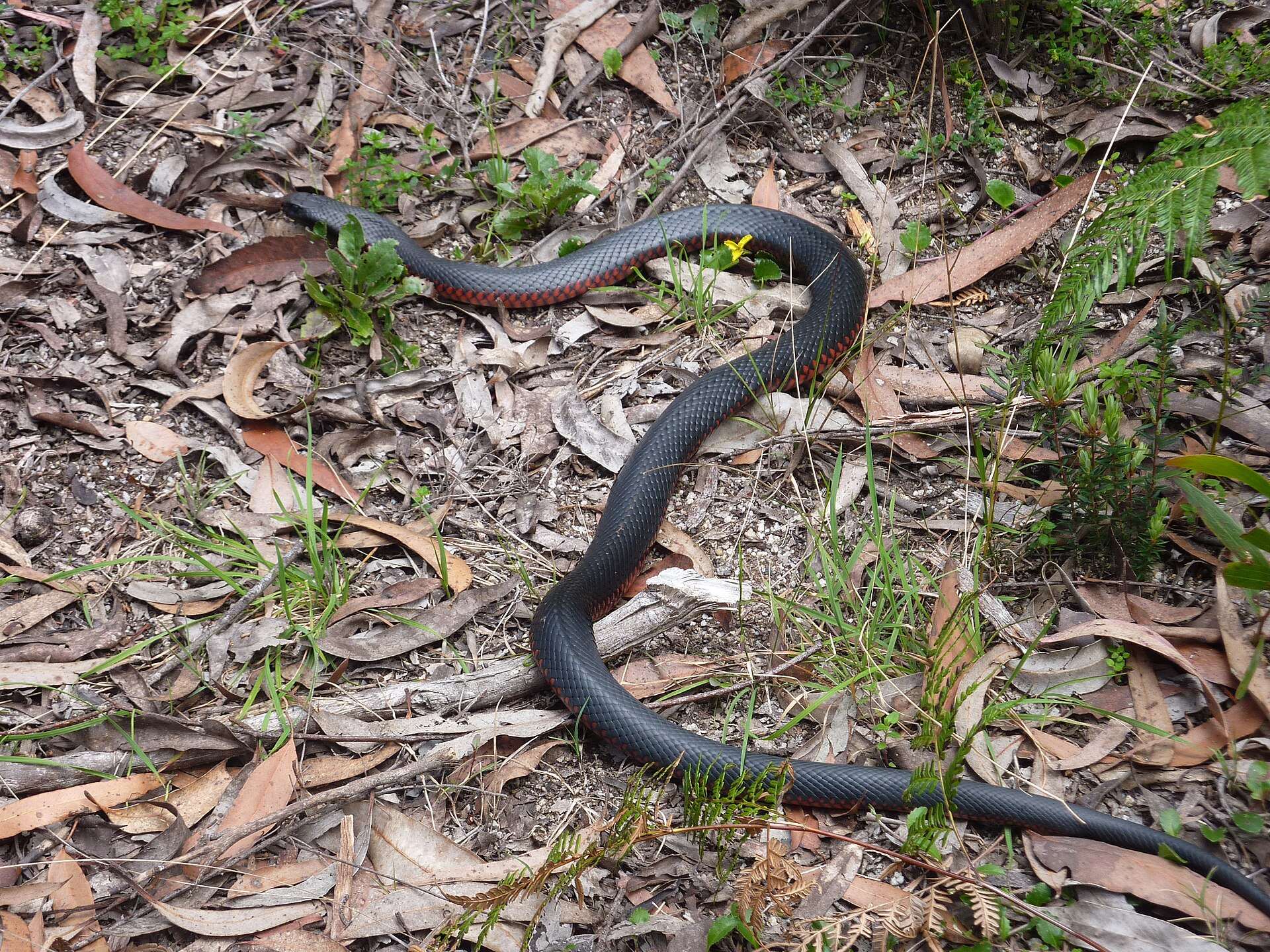
A glossy black snake of eastern Australia with bright red or pink scales along its lower sides and belly. It usually lives near creeks, swamps and dams, and is shy unless cornered.

Is it dangerous?
Yes. Its venom can cause bleeding problems and muscle damage, although deaths are very rare. Anyone bitten should go to hospital immediately.
Do not approach. If someone is bitten, go to a hospital now.
At a glance
- Length
- 1.5–2.5 m
- Active
- By day
- Found in
- Eastern Australia
- Venom
- Anticoagulant and myotoxic
- Young
- Live young
- Habitat
- Streams and swamps, Farm dams and drains, Forest and woodland
- Diet
- Frogs and tadpoles, Fish, Lizards
Length shows a typical adult, then the largest recorded.
IUCN Red List status: Least Concern
Country guideSnakes of Australia
True size
Common death adderMedically significant
1 m at most
About two thirds of the height of a 1.7 m adult.
Usual range 0.5–1.0 m, the bar on the ruler.
Common tree snakeNon-venomous
2 m at most
About 1 times the height of a 1.7 m adult.
Usual range 1.2–2.0 m, the bar on the ruler.
Eastern brown snakeMedically significant
2.01 m at most
About 1 times the height of a 1.7 m adult.
Usual range 1.5–2.01 m, the bar on the ruler.
Banded kraitMedically significant
2.25 m at most
About 1.5 times the height of a 1.7 m adult.
Usual range 1.35–2.25 m, the bar on the ruler.
Tiger snakeMedically significant
2.4 m at most
About 1.5 times the height of a 1.7 m adult.
Usual range 1.2–2.4 m, the bar on the ruler.
Red-bellied black snakeMedically significant
2.5 m at most
About 1.5 times the height of a 1.7 m adult.
Usual range 1.5–2.5 m, the bar on the ruler.
Inland taipanMedically significant
2.5 m at most
About 1.5 times the height of a 1.7 m adult.
Usual range 2.0–2.5 m, the bar on the ruler.
Coastal taipanMedically significant
2.9 m at most
About 1.5 times the height of a 1.7 m adult.
Usual range 2.0–2.9 m, the bar on the ruler.
Each snake is drawn at the longest length in its profile, on the same scale as the adult. Length is to scale; thickness is not.
Identification
The red-bellied black snake is a medium-sized snake with a moderate to robust build and a head barely distinct from its neck1. Its head and back are a uniform glossy black, except for the snout, which is often pale brown1. The lowest scale rows on the sides and the outer edges of the belly scales are bright crimson, fading to duller red, orange or pink in the middle of the belly; in the north of its range the belly may be greyish-pink to white1. Its body scales are smooth and glossy, and its eye has a dark iris, a round pupil and an obvious brow ridge1.
Adults are usually 1.5–2 m long, and males grow slightly larger than females1. The longest reliably reported total length is about 2.5 m (2,540 mm)1.
Distribution
The red-bellied black snake is found only in eastern Australia1,2. It occurs in scattered populations in northern and central eastern Queensland, and then more continuously from south-eastern Queensland through eastern New South Wales and Victoria1. A separate population lives at the southern end of the Mount Lofty Ranges in South Australia1. Despite claims to the contrary, it does not occur on Kangaroo Island1.
Habitat
This snake is usually found in moist places, especially along streams and around swamps and lagoons, within forests, woodlands and grasslands, although it may also turn up well away from water1. It lives in disturbed areas and on rural properties too, and is often seen around drainage channels and farm dams1. It shelters in thick clumps of grass, logs, mammal burrows and under large rocks, and each snake seems to keep several favourite shelter sites within its home range1. In south-east Queensland it is most often met in wetter vegetation, and is often found basking in sunny patches of grass9.
Behaviour
The red-bellied black snake is mainly active by day, but it can stay active well into the evening when the weather is warm1. Active snakes keep their body temperature at about 28–31 °C by moving between sun and shade1. It is a shy snake: when approached it often freezes, and if a person comes too close it usually flees towards the nearest shelter, which can look like an attack if that shelter is behind the person1. If it cannot escape, it raises its forebody, spreads its neck, hisses loudly and may make mock strikes with its mouth closed1. To escape a predator it may slip into water, and it has been recorded staying fully submerged for as long as 23 minutes1. In spring, males travel up to 1,220 m in a day looking for females, and rival males wrestle each other when they meet1.
Diet
It eats a wide range of animals with backbones, including fish, tadpoles, frogs, lizards, other snakes (even its own species) and mammals1. In Queensland its main prey is frogs9. It hunts widely on land and in water and can climb several metres; in water it may forage with only its head under the surface or dive completely, and it has been seen stirring up mud, probably to flush out hidden prey1. The introduced cane toad is deadly to it, and a snake can die quickly after eating or even mouthing one1.
Reproduction
The red-bellied black snake gives birth to live young, and it is the only member of its genus to do so; the other black snakes all lay eggs1. Mating takes place mainly in spring, from early October to November1. Four to five months later the female gives birth to 5–18 young, each born inside a thin membrane and measuring about 28 cm1. In some areas, pregnant females gather in small groups of up to six, basking together and sharing a night-time shelter1. The young reach maturity in two to three years1.
Venom and medical significance
This is a venomous snake of medical importance: the World Health Organization lists Australia’s black snakes (Pseudechis species) in Category 2, which covers highly venomous snakes that can cause disability or death5. Its venom mainly affects blood clotting and muscles, and symptoms include bleeding, pain or swelling at the bite, nausea, vomiting, headache, abdominal pain, sweating, muscle pain and weakness, and red-brown urine1,3. In a study of 81 confirmed bites, 70% of patients developed effects through the body; among them, 61% had a clotting abnormality and 12% had muscle damage, and one patient needed help with breathing3. It caused 16% of the snake envenomings in Australia in 2005–2015 where the snake was identified, behind only brown and tiger snakes, yet neither study recorded a death and very few deaths have ever been attributed to it1,3,4. Tiger snake antivenom is recommended for its bites, and black snake antivenom can also be used3. Anyone bitten should go to hospital immediately.
Conservation
The red-bellied black snake is listed as Least Concern on the IUCN Red List (assessment published in 2018)6. It is still fairly common in some areas, but its close link with wetlands makes it vulnerable when these are drained or badly managed1. Cane toads are thought to have hit its numbers hard in the north of its range, including around Brisbane, although there are signs of recovery in some areas1,9. Where toads have been present for decades, black snakes have evolved greater resistance to toad toxin and less interest in eating toads, in fewer than 23 snake generations since toads arrived in 19357. In Queensland, all wildlife is protected under the Nature Conservation Act 19928.
Similar species
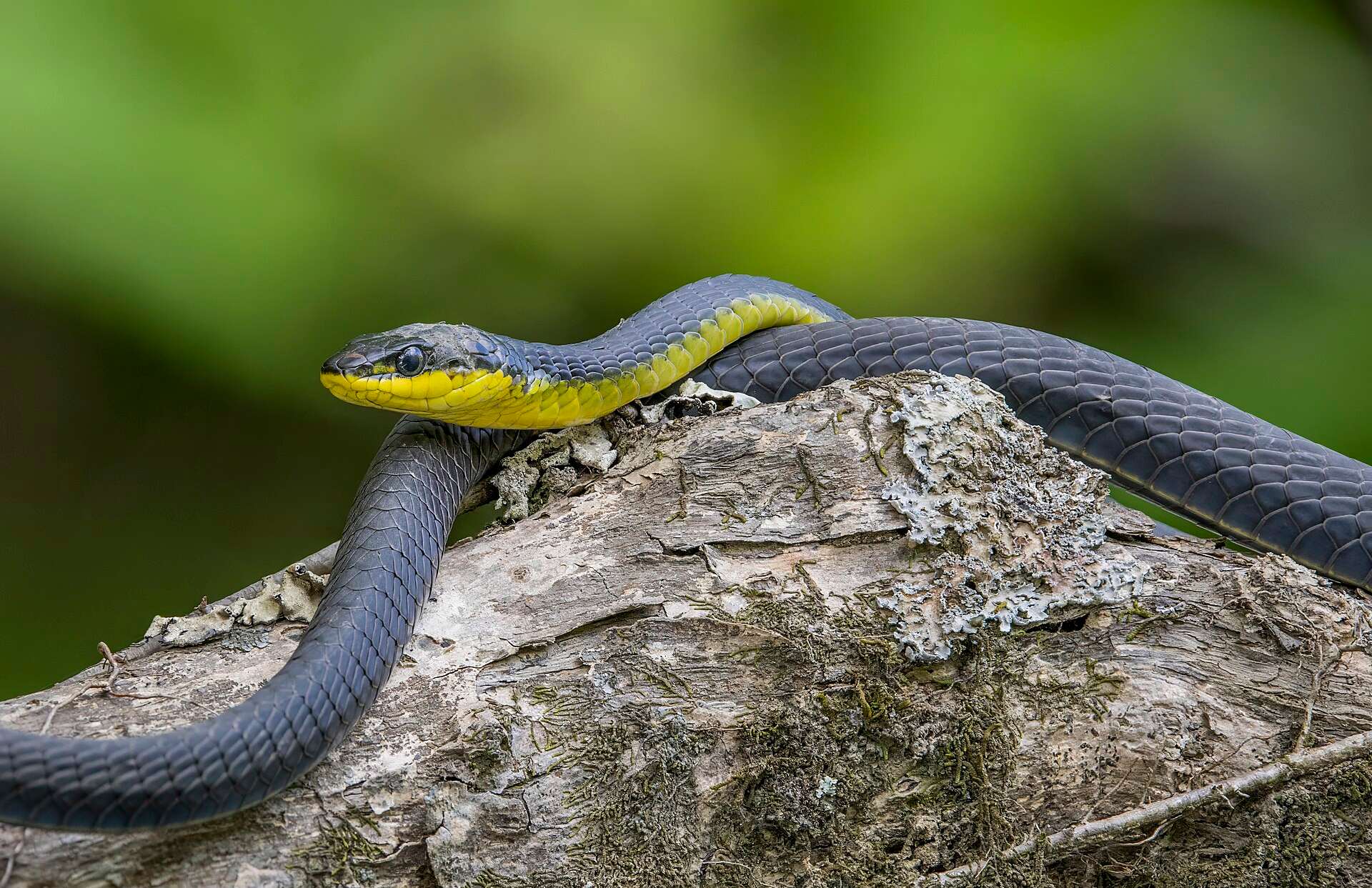
The venomous eastern small-eyed snake (Cryptophis nigrescens) is smaller, reaching at most about 1.2 m, and has steely-black skin with pink belly scales; its pink colour does not extend up onto the sides, and its eyes are tiny8,9. The Australian Museum also lists the blue-bellied black snake (Pseudechis guttatus) and copperheads (Austrelaps) as possible confusions1. The harmless common tree snake (Dendrelaphis punctulatus) can be almost black and is sometimes killed when mistaken for a venomous black snake; it is far more slender, with a whip-like tail, large eyes and usually a lemon-yellow belly8. These differences are not a safe basis for handling any snake. Keep your distance from every snake you cannot identify.
In captivity
The red-bellied black snake is a venomous snake and is not suitable as a pet. Captive snakes readily eat rats and mice and are described as voracious feeders1. Keeping them carries real risk: in one hospital study, 10 of the 57 people with systemic envenoming were snake handlers3. In Queensland it is an offence to take a snake from the wild, and keeping any snake requires a wildlife licence8.
Look-alikes
Don’t confuse it with…
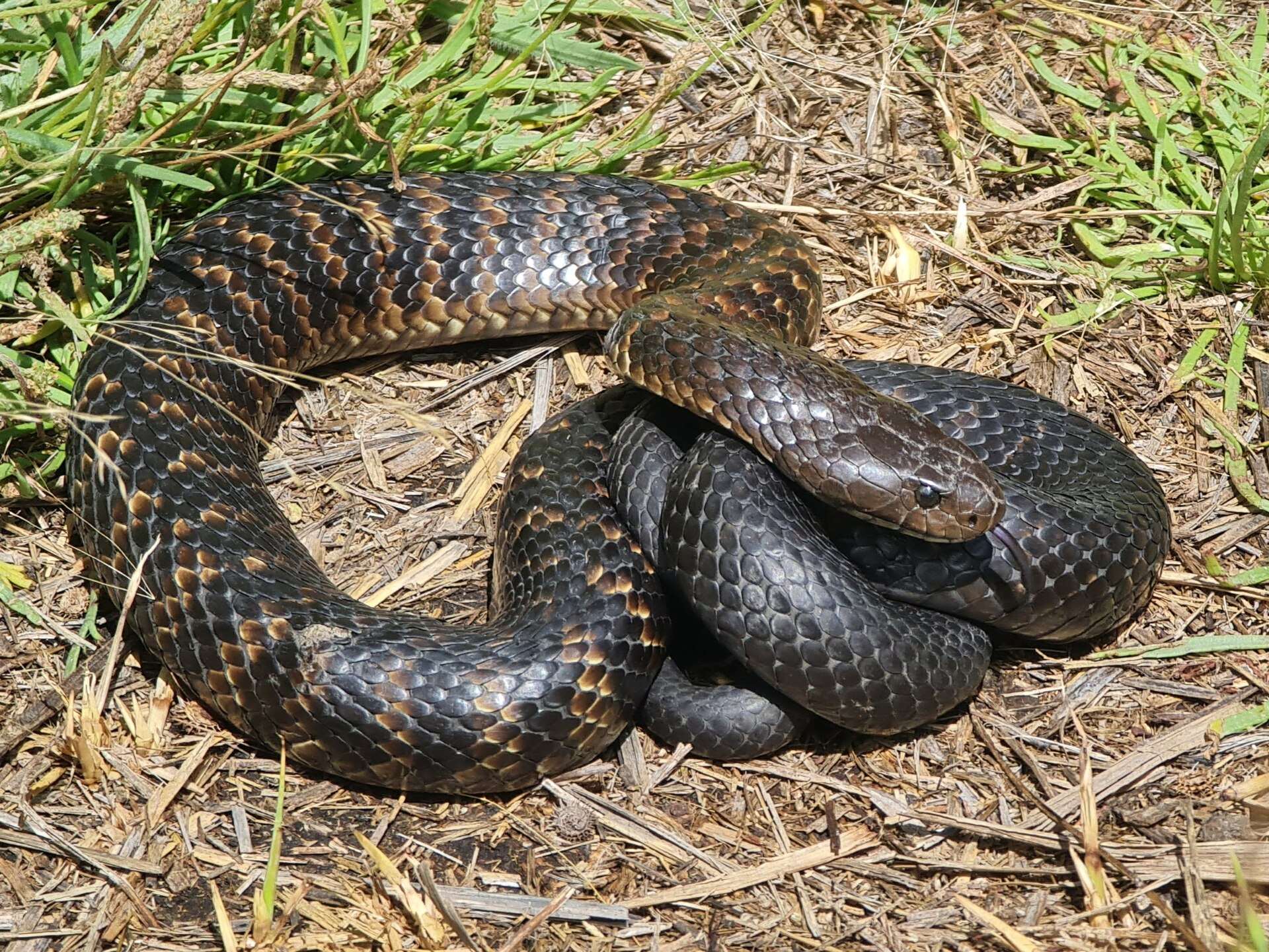
These snakes are often mistaken for each other. Use the differences to learn, never as a reason to handle a snake.
References
- 1
Beatson, C. (2026). Red-bellied Black Snake. Australian Museum. australian.museum
- 2
Uetz, P. et al. (eds.) (2026). Pseudechis porphyriacus (Shaw, 1794). The Reptile Database. reptile-database.reptarium.cz
- 3
Churchman, A., O'Leary, M.A., Buckley, N.A., Page, C.B., Tankel, A., Gavaghan, C., Holdgate, A., Brown, S.G.A. & Isbister, G.K. (2010). Clinical effects of red-bellied black snake (Pseudechis porphyriacus) envenoming and correlation with venom concentrations: Australian Snakebite Project (ASP-11). Medical Journal of Australia 193(11): 696–700. doi:10.5694/j.1326-5377.2010.tb04108.x mja.com.au
- 4
Johnston, C.I., Ryan, N.M., Page, C.B., Buckley, N.A., Brown, S.G.A., O'Leary, M.A. & Isbister, G.K. (2017). The Australian Snakebite Project, 2005–2015 (ASP-20). Medical Journal of Australia 207(3): 119–125. doi:10.5694/mja17.00094 mja.com.au
- 5
World Health Organization (2017). Guidelines for the production, control and regulation of snake antivenom immunoglobulins. WHO Technical Report Series No. 1004, Annex 5, Appendix 1: Worldwide distribution of medically important venomous snakes. cdn.who.int
- 6
Shea, G., Cogger, H. & Greenlees, M. (2018). Pseudechis porphyriacus. The IUCN Red List of Threatened Species 2018: e.T42493274A42493282. iucnredlist.org
- 7
Phillips, B.L. & Shine, R. (2006). An invasive species induces rapid adaptive change in a native predator: cane toads and black snakes in Australia. Proceedings of the Royal Society B 273(1593): 1545–1550. doi:10.1098/rspb.2006.3479 pmc.ncbi.nlm.nih.gov
- 8
Queensland Government, Department of the Environment, Tourism, Science and Innovation. Frequently asked questions about snakes. environment.desi.qld.gov.au
- 9
Queensland Government, Department of the Environment, Tourism, Science and Innovation. Snakes of South-East Queensland. environment.desi.qld.gov.au
Play
Play as the red-bellied black snake.
Its real pattern is a skin in Snake. Every run ends with a fact.