
Inland taipan
Oxyuranus microlepidotus (McCoy, 1879)
Also called Fierce snake, Small-scaled snake
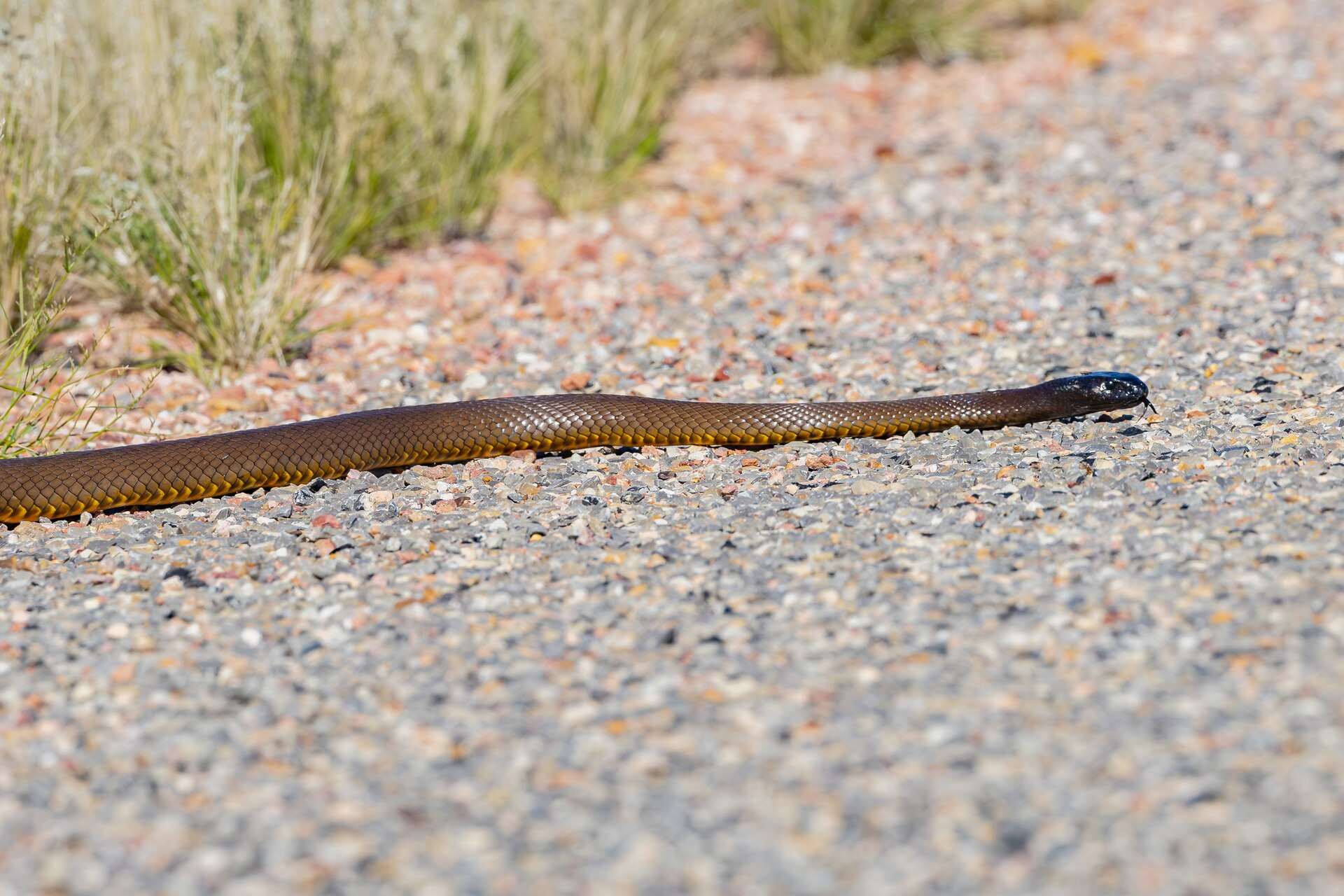
A shy, robust brown snake of the remote floodplains of inland Australia. Its venom is rated the most toxic of any snake in laboratory tests, yet very few people have ever been bitten.

Is it dangerous?
Yes. In lab tests its venom is the most toxic of any snake, but it is shy and rarely bites. Get hospital care immediately.
Do not approach. If someone is bitten, go to a hospital now.
At a glance
- Length
- 2.0–2.5 m
- Active
- By day
- Found in
- Inland Australia
- Venom
- Neurotoxic and haemotoxic
- Young
- Lays eggs
- Habitat
- Cracking-clay floodplains, Gibber plains, Dunes
- Diet
- Rats, Mice, Small marsupials
Length shows a typical adult, then the largest recorded.
IUCN Red List status: Least Concern
Country guideSnakes of Australia
True size
Common death adderMedically significant
1 m at most
About two thirds of the height of a 1.7 m adult.
Usual range 0.5–1.0 m, the bar on the ruler.
Eastern brown snakeMedically significant
2.01 m at most
About 1 times the height of a 1.7 m adult.
Usual range 1.5–2.01 m, the bar on the ruler.
Banded kraitMedically significant
2.25 m at most
About 1.5 times the height of a 1.7 m adult.
Usual range 1.35–2.25 m, the bar on the ruler.
Tiger snakeMedically significant
2.4 m at most
About 1.5 times the height of a 1.7 m adult.
Usual range 1.2–2.4 m, the bar on the ruler.
Inland taipanMedically significant
2.5 m at most
About 1.5 times the height of a 1.7 m adult.
Usual range 2.0–2.5 m, the bar on the ruler.
Red-bellied black snakeMedically significant
2.5 m at most
About 1.5 times the height of a 1.7 m adult.
Usual range 1.5–2.5 m, the bar on the ruler.
Coastal taipanMedically significant
2.9 m at most
About 1.5 times the height of a 1.7 m adult.
Usual range 2.0–2.9 m, the bar on the ruler.
Black mambaMedically significant
4.5 m at most
About 2.5 times the height of a 1.7 m adult.
Usual range 2.5–4.5 m, the bar on the ruler.
Each snake is drawn at the longest length in its profile, on the same scale as the adult. Length is to scale; thickness is not.
Identification
The inland taipan is a medium to large snake with a robust build and a deep, rectangular head1. Its back ranges from pale fawn to yellowish-brown or dark brown, and the head and neck are often several shades darker than the body1. Many back scales have a blackish edge, which together form a broken herringbone pattern, and the belly is yellowish with orange blotches1. Adults average about 2 m long, and the longest recorded total length is 2.5 m1.
It was first described in 1879 in the brown snake genus Diemenia and has since been placed in several other genera before Oxyuranus1,2. Its name means “small-scaled”2.
Distribution
The inland taipan is found only in Australia. It lives mainly in the Channel Country of south-western Queensland and north-eastern South Australia1.
There are two old records further south-east: the junction of the Murray and Darling rivers in north-western Victoria (1879) and “Fort Bourke” in New South Wales (1882). The species has not been collected in either state since then1. The Reptile Database describes it as rare2.
Habitat
This snake lives on the deep cracking-clay and cracking-loam soils of inland floodplains. It also uses nearby gibber (stony) plains, dunes and rocky outcrops where there is cover1.
The plants in these areas are usually sparse, mostly saltbush-family shrubs, lignum and the odd eucalypt along water channels1. The snakes shelter in deep soil cracks, crevices and the burrows of mammals1.
Behaviour
The inland taipan is active above ground by day, mostly in the first half of the morning, when it basks and hunts near soil cracks and burrows before retreating to shelter. In cooler weather it may also be active in the afternoon1. Its colour changes with the seasons: it becomes darker in winter, which probably helps it warm up quickly, and paler in summer1.
Despite the name “fierce snake”, it is shy and rarely seen, partly because it lives in remote areas1. If provoked, it first raises its forebody in a low S-shaped curve as a warning, and may then strike1.
Diet
In the wild the inland taipan seems to eat only small to medium-sized mammals, especially the long-haired rat, as well as introduced house mice and small marsupials called dasyurids1. It usually corners prey in a burrow or soil crack and bites it several times in quick succession1.
Long-haired rats boom in good seasons and almost vanish in droughts, so the snakes grow fat when rats are plentiful and live on stored fat when they are scarce1.
Reproduction
The inland taipan lays eggs2. Male combat and mating have been seen in late winter, and females carrying eggs are found by mid-spring1.
Clutches contain 11 to 20 eggs, with 16 on average. The eggs take 9 to 11 weeks to hatch at 27–30 °C, and the hatchlings are about 47 cm long1. In captivity, a female can lay two clutches in one breeding season1.
Venom and medical significance
In laboratory tests on mice, inland taipan venom is rated the most toxic of all snake venoms1. It is strongly neurotoxic and contains an enzyme (hyaluronidase) that helps it spread through the body1. It also contains three-finger toxins, phospholipase A2 toxins and prothrombin activators, which affect nerves, muscles and blood clotting3. Reported effects include headache, vomiting, collapse, paralysis and serious clotting problems1,4.
Bites are very rare: only about 12 cases have been formally documented4. The WHO places it in Category 2 in Australia, a group that includes highly venomous snakes that bite people less often, for example because they live far from large populations5. People who received prompt hospital treatment have survived1. Anyone bitten must seek medical care immediately.
Conservation
The IUCN Red List classifies the inland taipan as Least Concern, based on an assessment published in 20186. Its remote habitat means people rarely come across it1.
It has not been recorded in Victoria or New South Wales since the 1880s, and the Australian Museum lists it as presumed extinct in those two states1.
Similar species
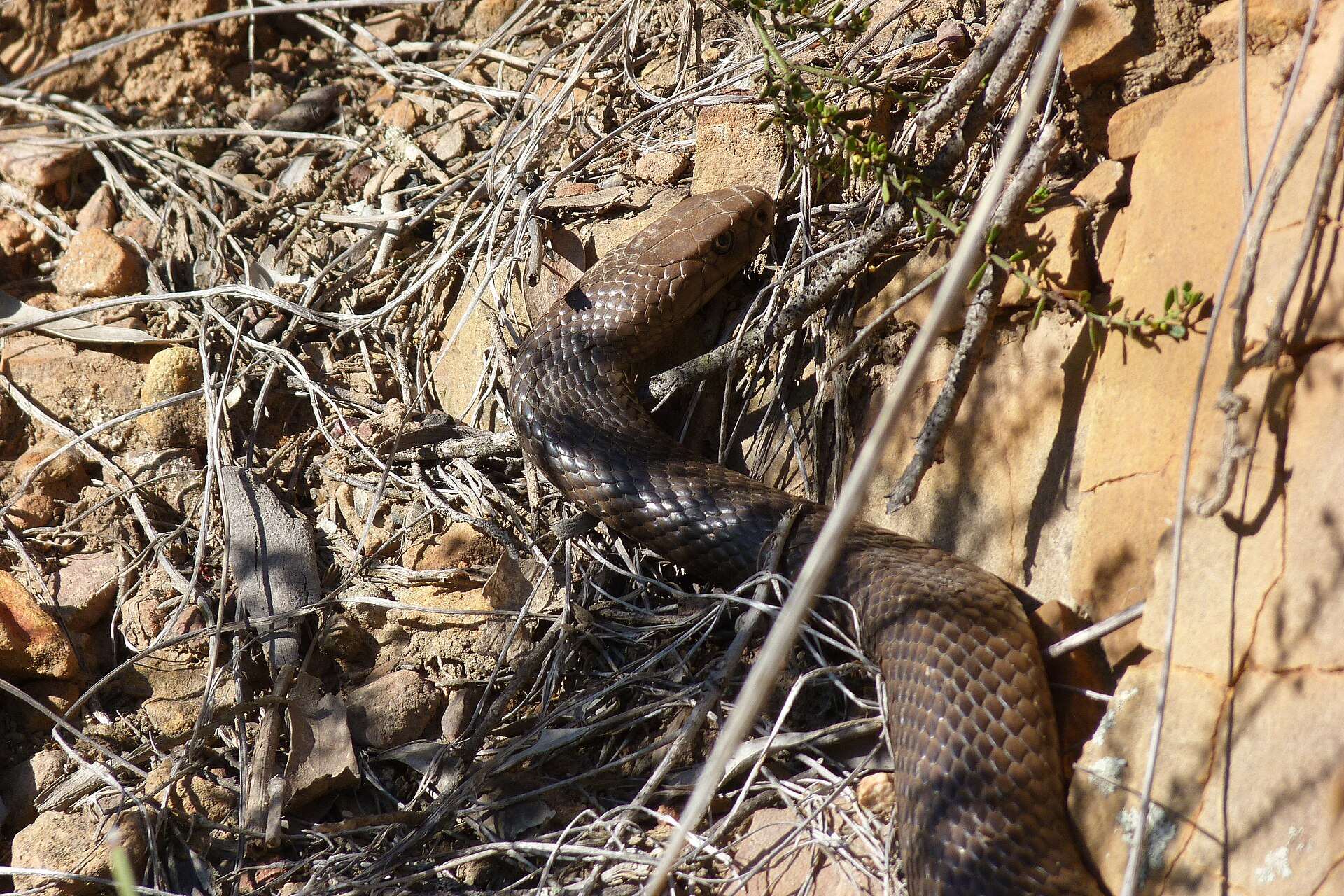
Within its own range, the inland taipan can be confused with brown snakes, such as the western and eastern brown snakes1. The eastern brown snake, for example, has a slender to moderate build, a smallish head barely distinct from the neck and fairly even colouring7. The inland taipan is more robust, with a deep rectangular head, a head and neck often darker than the body, and a herringbone pattern of dark scale edges1.
These features are not a safe basis for handling any snake. Brown snakes are also dangerously venomous5, so keep away from all of them.
In captivity
Inland taipans are kept in some educational reptile exhibits and by specialist keepers, and many experienced keepers describe them as placid1,4. Even so, bites in captivity can cause serious envenoming. In one recent case, a keeper at a public reptile exhibit in Florida, USA, was bitten during routine care and needed hospital treatment with antivenom4. It is not a suitable pet.
Look-alikes
Don’t confuse it with…
These snakes are often mistaken for each other. Use the differences to learn, never as a reason to handle a snake.
References
- 1
Beatson, C. (2026). Inland Taipan. Australian Museum. australian.museum
- 2
Uetz, P. et al. (eds.) (2026). Oxyuranus microlepidotus (McCoy, 1879). The Reptile Database. reptile-database.reptarium.cz
- 3
Paz, G.G., Spencer, P.J., Pimenta, D.C. & Beraldo-Neto, E. (2025). Exploring the venom diversity of Australian taipans: comparative characterization of Oxyuranus microlepidotus and Oxyuranus scutellatus. Toxins 17(10): 488. doi.org
- 4
Weinstein, S.A., Keyler, D.E., Jensen, J.P., Sawyers, R., Steward, H., Facente, J. & Dean, D. (2025). Envenoming by a captive inland taipan, Oxyuranus microlepidotus (McCoy, 1879), Elapidae: a case report, observations on clinical efficacy of expired antivenom and review of O. microlepidotus envenoming. Toxicon 254: 108210. doi.org
- 5
World Health Organization (2017). Guidelines for the production, control and regulation of snake antivenom immunoglobulins. WHO Technical Report Series No. 1004, Annex 5, Appendix 1: Worldwide distribution of medically important venomous snakes. cdn.who.int
- 6
Wilson, S., Dickman, C., Hobson, R. & Sanderson, C. (2018). Oxyuranus microlepidotus. The IUCN Red List of Threatened Species 2018: e.T42493150A42493160. iucnredlist.org
- 7
Beatson, C. (2026). Eastern Brown Snake. Australian Museum. australian.museum
Play
Play as the inland taipan.
Its real pattern is a skin in Snake. Every run ends with a fact.