
Mozambique spitting cobra
Naja mossambica Peters, 1854
Also called M'fezi, Mosambiekse spoegkobra
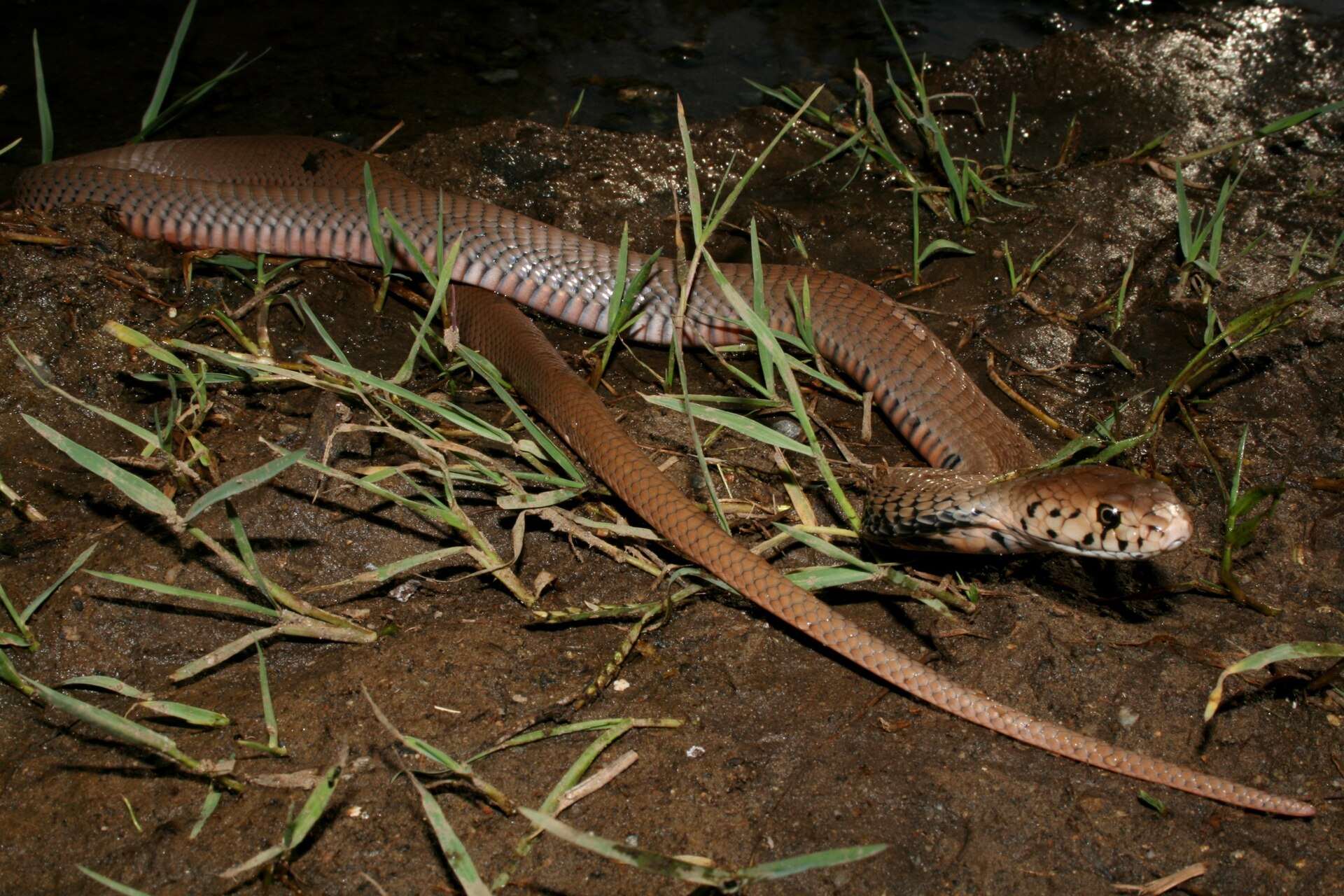
A brown spitting cobra of south-eastern Africa with a salmon-pink to yellow belly and dark bands on the throat. It often enters homes at night and can spit venom without raising a hood.

Is it dangerous?
Yes. Its bite destroys tissue, and venom spat into the eyes causes severe pain and can blind. Anyone bitten or spat at in the eyes needs urgent hospital care.
Do not approach. If someone is bitten, go to a hospital now.
At a glance
- Length
- 1.2–1.8 m
- Active
- At night
- Found in
- South-eastern Africa
- Venom
- Cytotoxic
- Young
- Lays eggs
- Habitat
- Savanna, Lowland forest, Rocky areas
- Diet
- Frogs and toads, Small mammals, Birds
Length shows a typical adult, then the largest recorded.
IUCN Red List status: Least Concern
Country guideSnakes of South Africa
True size
Philippine cobraMedically significant
1.41 m at most
About three quarters of the height of a 1.7 m adult.
Usual range 1.0–1.41 m, the bar on the ruler.
Mozambique spitting cobraMedically significant
1.8 m at most
About as long as a 1.7 m adult is tall.
Usual range 1.2–1.8 m, the bar on the ruler.
Javan spitting cobraMedically significant
1.85 m at most
About as long as a 1.7 m adult is tall.
Usual range 1.38–1.85 m, the bar on the ruler.
Black-necked spitting cobraMedically significant
2.2 m at most
About 1.5 times the height of a 1.7 m adult.
Usual range 1.25–2.2 m, the bar on the ruler.
Indian cobraMedically significant
2.2 m at most
About 1.5 times the height of a 1.7 m adult.
Usual range 1.25–2.2 m, the bar on the ruler.
Cape cobraMedically significant
2.3 m at most
About 1.5 times the height of a 1.7 m adult.
Usual range 1.2–2.3 m, the bar on the ruler.
Monocled cobraMedically significant
2.3 m at most
About 1.5 times the height of a 1.7 m adult.
Usual range 1.5–2.3 m, the bar on the ruler.
Black mambaMedically significant
4.5 m at most
About 2.5 times the height of a 1.7 m adult.
Usual range 2.5–4.5 m, the bar on the ruler.
Each snake is drawn at the longest length in its profile, on the same scale as the adult. Length is to scale; thickness is not.
Identification
The Mozambique spitting cobra is a shiny, light to dark brown snake with black skin showing between its scales6. Its belly is salmon pink to yellow, with a distinct dark band and dark blotches on the throat6. These throat bands show when it rears up7. Like other cobras it has smooth scales5. It can spread a hood, but it does not always do so when it spits2.
Adults average about 1.2 m long7, and the largest reach about 1.8 m3.
Distribution
This cobra lives in south-eastern Africa1. The Reptile Database lists it from South Africa, Eswatini, Mozambique, Zimbabwe, Botswana, north-eastern Namibia and the far south-east of Angola, north to Zambia, Malawi, the Democratic Republic of the Congo and Tanzania, including Pemba Island1. The database also lists Somalia1. In South Africa it occurs on the eastern side of the country, in KwaZulu-Natal, Mpumalanga, Limpopo and North West2,7.
Habitat
Its favoured habitats are rocky savanna and lowland forest, where it shelters in hollow logs and termite mounds, often close to water7. It lives on the ground but also climbs into small shrubs7. It is common in most of its range and is often found around homes5.
Behaviour
The Mozambique spitting cobra is active on overcast days but mostly at night, and it often ends up inside houses2. It is quick to spit its venom, which it can do without raising a hood and even from inside a rock crack5. Spitting is only for defence, not for catching prey, and a spitting cobra usually releases only a small amount of venom with each spit, so it can spit several times in a row5. When threatened, it may also play dead7.
Diet
Its diet consists largely of frogs, small mammals, birds and other snakes, including puff adders2. Toads, lizards and poultry are also recorded7. Southern African cobras in general eat a broad range of amphibians, reptiles, mammals and, less often, birds8.
Reproduction
The Mozambique spitting cobra lays eggs1. A female lays between 10 and 22 eggs in midsummer7. Males grow as large as females in this species8.
Venom and medical significance
The venom is mainly cytotoxic, which means it destroys tissue: bites cause severe pain, spreading swelling and blisters, and in some cases severe tissue damage2,4,10. Venom spat into the eyes causes instant pain and inflammation and, if it is not removed, can cause permanent blindness5. In one South African study, 94% of bites happened inside homes, and 81% of those victims were asleep10. It causes many of the serious snakebites in southern Africa, and in South African records it is second only to the puff adder in the number of bites, although deaths are rare2,11. The World Health Organization lists it among the snakes of highest medical importance (Category 1) in countries including South Africa, Eswatini, Zimbabwe and Tanzania9. Polyvalent antivenom, including South Africa’s SAVP product, which is made partly with this cobra’s venom, works best when given early, so anyone bitten, or spat at in the eyes, should go to hospital immediately4,10,12.
Conservation
The Mozambique spitting cobra is listed as Least Concern on the IUCN Red List (2022 version of a 2019 assessment)13. It is a common species in most of its range5.
Similar species
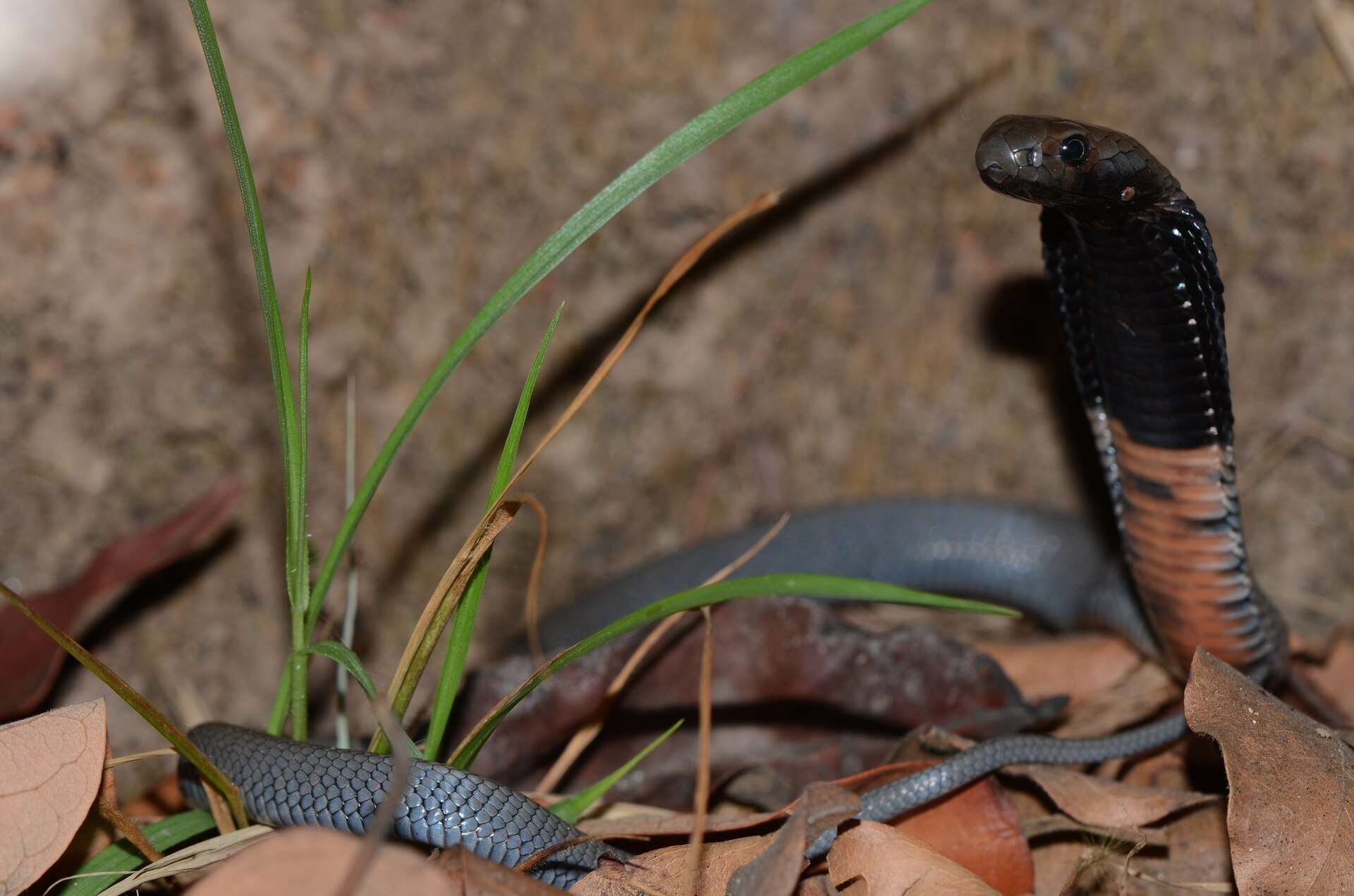
It is easily confused with the snouted cobra (Naja annulifera), which is usually brown to mustard-yellow with a darker or mottled back, often has a dark “tear” mark under the eye and has an off-yellow belly with only faint markings6. The black-necked spitting cobra (Naja nigricollis) looks similar too, but it is usually uniform dark olive-brown to black above, and in southern Africa it occurs only in northern Namibia, the Caprivi Strip and the far north of Mozambique5.
These differences are not a safe basis for handling any snake. Keep your distance from every snake you cannot identify.
In captivity
The Mozambique spitting cobra is a dangerous venomous snake2 and is not suitable as a pet. Snake catchers are often spat at when handling spitting cobras, and some handlers become sensitised to the venom and develop allergic reactions5.
Look-alikes
Don’t confuse it with…
These snakes are often mistaken for each other. Use the differences to learn, never as a reason to handle a snake.
References
- 1
Uetz, P. et al. (eds.) (2026). Naja mossambica Peters, 1854. The Reptile Database. reptile-database.reptarium.cz
- 2
African Snakebite Institute. Mozambique Spitting Cobra (Naja mossambica) species account. africansnakebiteinstitute.com
- 3
African Snakebite Institute (2022). Mozambique Spitting Cobra (Naja mossambica) species sheet. africansnakebiteinstitute.com
- 4
African Snakebite Institute (2024). Snakebite profile: Mozambique Spitting Cobra, Naja mossambica. africansnakebiteinstitute.com
- 5
African Snakebite Institute (2019). Spitting snakes of southern Africa. africansnakebiteinstitute.com
- 6
African Snakebite Institute (2019). Snake comparison: Mozambique Spitting Cobra vs Snouted Cobra. africansnakebiteinstitute.com
- 7
Iziko Museums of South Africa. Naja mossambica (Mozambique spitting cobra). Biodiversity Explorer. biodiversityexplorer.info
- 8
Shine, R., Branch, W.R., Webb, J.K., Harlow, P.S., Shine, T. & Keogh, J.S. (2007). Ecology of cobras from southern Africa. Journal of Zoology 272(2): 183–193. doi.org
- 9
World Health Organization (2017). Guidelines for the production, control and regulation of snake antivenom immunoglobulins. WHO Technical Report Series No. 1004, Annex 5. cdn.who.int
- 10
Tilbury, C.R. (1982). Observations on the bite of the Mozambique spitting cobra (Naja mossambica mossambica). South African Medical Journal 61(9): 308–313. pubmed.ncbi.nlm.nih.gov
- 11
Naik, H. & Alexander, G.J. (2025). The incidence of snakebite in South Africa and the challenges associated with lack of reporting. Transactions of the Royal Society of Tropical Medicine and Hygiene 119(7): 788–795. doi.org
- 12
African Snakebite Institute (2025). Antivenom 'crisis'. africansnakebiteinstitute.com
- 13
Verburgt, L., Pietersen, D., Farooq, H., Chapeta, Y., Wagner, P., Safari, I. & Chenga, J. (2022). Naja mossambica (amended version of 2019 assessment). The IUCN Red List of Threatened Species 2022: e.T20878771A219349342. iucnredlist.org
Play
Play as the mozambique spitting cobra.
Its real pattern is a skin in Snake. Every run ends with a fact.