
Common tree snake
Dendrelaphis punctulatus (Gray, 1826)
Also called Green tree snake, Yellow-bellied black snake
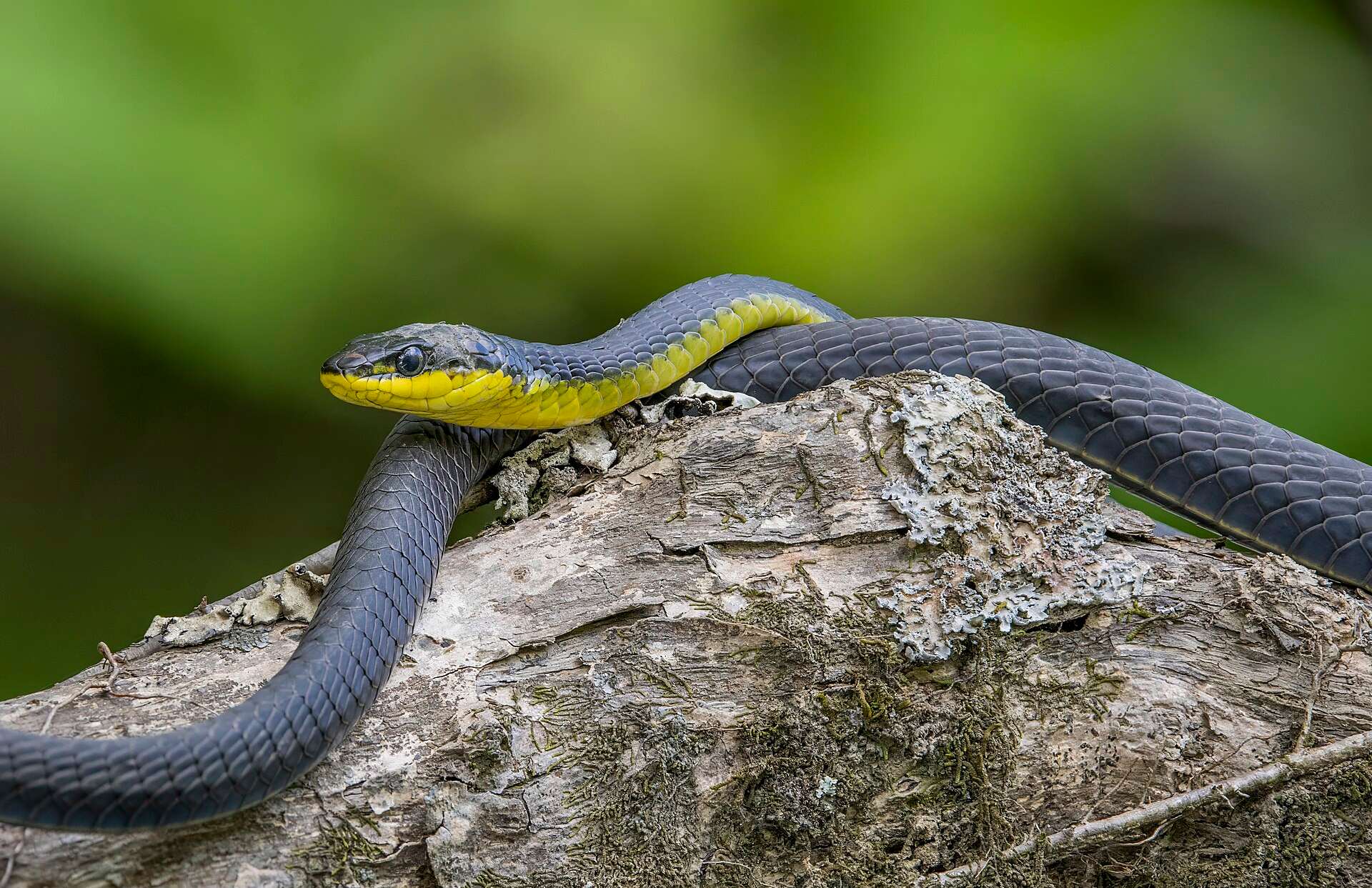
A very slender, fast-moving tree snake of northern and eastern Australia with large eyes and a whip-like tail. It may be green, olive, brown, black or blue, usually with a yellow belly.

Is it dangerous?
No. It has no fangs or venom and bites only as a last resort. It is sometimes mistaken for a venomous black snake.
Harmless to people, but it may bite if handled. Treat any snake you can’t identify as venomous.
Snakebite first aidAt a glance
- Length
- 1.2–2.0 m
- Active
- By day
- Found in
- Northern and eastern Australia, New Guinea
- Venom
- None
- Young
- Lays eggs
- Habitat
- Rainforest, Eucalypt woodland, Riverside forest
- Diet
- Frogs, Skinks and other lizards, Birds
Length shows a typical adult, then the largest recorded.
IUCN Red List status: Least Concern
Country guideSnakes of Australia
True size
Common death adderMedically significant
1 m at most
About two thirds of the height of a 1.7 m adult.
Usual range 0.5–1.0 m, the bar on the ruler.
Common tree snakeNon-venomous
2 m at most
About 1 times the height of a 1.7 m adult.
Usual range 1.2–2.0 m, the bar on the ruler.
Eastern brown snakeMedically significant
2.01 m at most
About 1 times the height of a 1.7 m adult.
Usual range 1.5–2.01 m, the bar on the ruler.
BoomslangMedically significant
2.3 m at most
About 1.5 times the height of a 1.7 m adult.
Usual range 1.3–2.3 m, the bar on the ruler.
Red-bellied black snakeMedically significant
2.5 m at most
About 1.5 times the height of a 1.7 m adult.
Usual range 1.5–2.5 m, the bar on the ruler.
Inland taipanMedically significant
2.5 m at most
About 1.5 times the height of a 1.7 m adult.
Usual range 2.0–2.5 m, the bar on the ruler.
Coastal taipanMedically significant
2.9 m at most
About 1.5 times the height of a 1.7 m adult.
Usual range 2.0–2.9 m, the bar on the ruler.
Carpet pythonNon-venomous
4 m at most
About 2.5 times the height of a 1.7 m adult.
Usual range 2.0–4.0 m, the bar on the ruler.
Each snake is drawn at the longest length in its profile, on the same scale as the adult. Length is to scale; thickness is not.
Identification
The common tree snake is an agile, extremely slender snake with a whip-like tail1,2. Its colour varies from place to place: it may be grey, olive-green, various shades of brown, almost black or even blue above, and lighter snakes often have a grey or brown head that contrasts with the body2. The belly is usually lemon-yellow, but it can be white, olive, green or bluish2. It has large eyes and keen eyesight6. Besides “green tree snake”, it is sometimes called the yellow-bellied black snake3.
Adults average about 1.2 m long, and the largest reach 2 m2.
Distribution
The common tree snake lives in northern and eastern Australia and in Papua New Guinea1,4. Its range runs from the Kimberley region of Western Australia through the Northern Territory to Cape York and the Torres Strait, and then down the east coast into New South Wales1,4. In Queensland it is widespread along the east coast and on Cape York Peninsula, and it is common throughout Brisbane1,2. A form once treated as a subspecies, Dendrelaphis striolatus, is now regarded as a separate species4.
Habitat
This snake uses a wide variety of habitats, from woodland and rainforest to tropical gardens1. In Queensland it lives in coastal forest, rainforest, wet and dry eucalypt forest and riverside vegetation, and it is usually seen in eucalypt woodland or rainforest2,3. In New South Wales it is found in rainforest, open forest and rural areas, as well as in suburban gardens6. It is often seen in trees, gardens and on verandahs, and sometimes even enters houses1.
Behaviour
The common tree snake is active by day, spending most of its life in trees and shrubs but also hunting on the ground1,2. At night it usually sleeps in tree hollows, crevices or foliage1. In a seven-year study of 131 snakes from a dark-coloured population near Townsville, activity peaked during the breeding season, at the change from the dry season to the wet season5. When it meets people it usually retreats quickly2. If threatened, it raises itself and inflates its body to show splashes of blue skin between its scales, and it often gives off an unpleasant smell1,2,3.
Diet
The common tree snake feeds mostly on frogs and skinks1. Other recorded prey includes birds, other reptiles, fish and occasionally small mammals2,6. Snakes studied near Townsville ate frogs, lizards and locusts5. It actively hunts frogs by day and is often seen around houses and gardens where frogs live2.
Reproduction
The common tree snake lays eggs4. Females lay clutches of 4–16 long, narrow eggs1. Near Townsville, breeding was strongly seasonal, and larger females laid larger clutches5. In the same study, females were larger than males in every measurement, including weight and head size5.
Venom and medical significance
The common tree snake has no fangs and no venom2,6. It is harmless to people, is not aggressive, and bites only as a last resort2,6. Its main risk is mistaken identity, because it is sometimes taken for a venomous black snake2. If there is any doubt about which snake caused a bite, seek medical care.
Conservation
The common tree snake is listed as Least Concern on the IUCN Red List (assessment published in 2018)7. It is also listed as Least Concern in Queensland under the Nature Conservation Act 19921. It remains common and widespread, including in suburban Brisbane1. Sadly, tree snakes are sometimes killed when people mistake them for venomous black snakes2.
Similar species
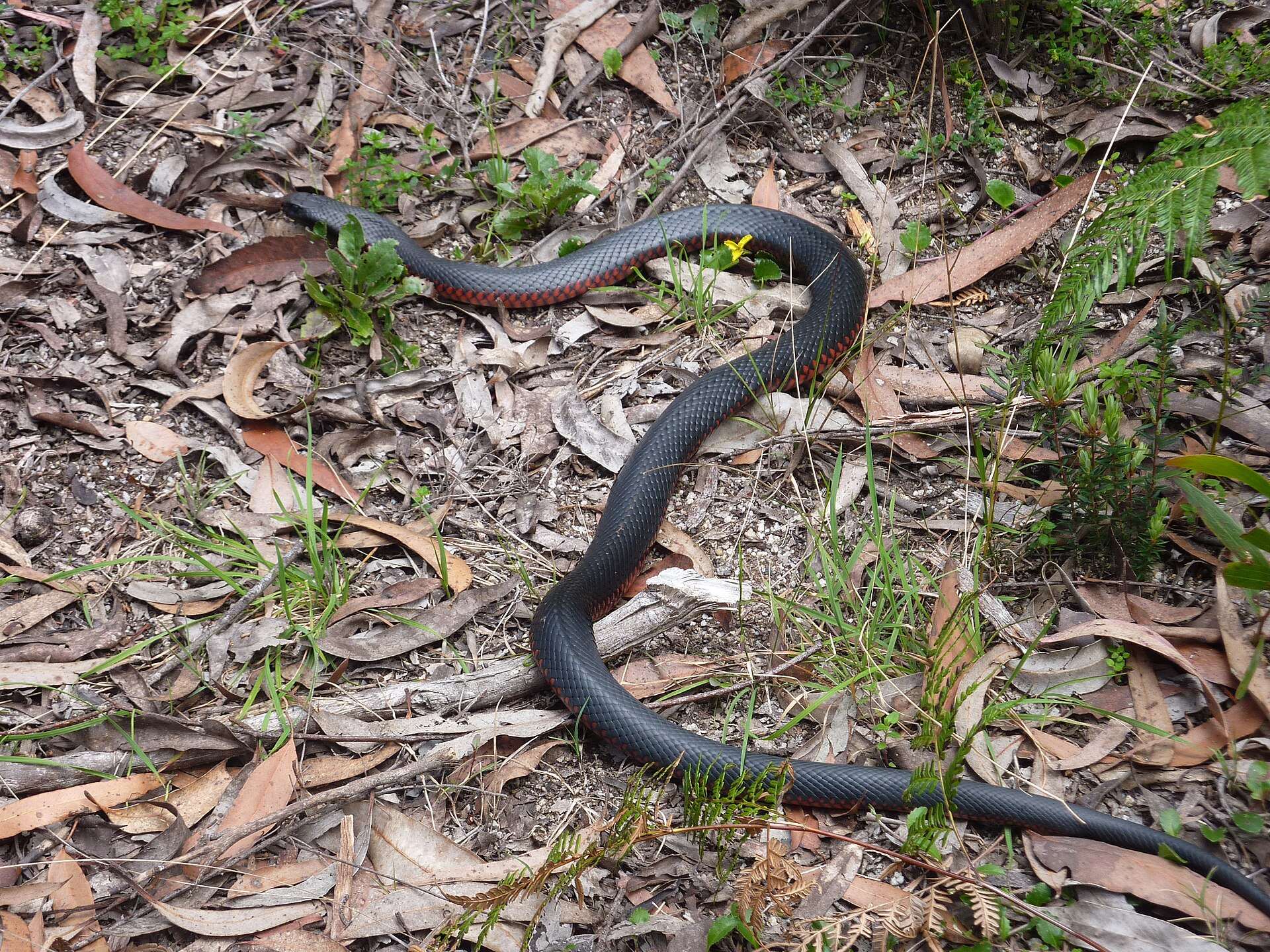
Common tree snakes, which can be almost black, are sometimes killed when mistaken for venomous black snakes2. The dangerous red-bellied black snake (Pseudechis porphyriacus) is glossy black with bright red or pink scales along the edge of its belly, whereas the tree snake is far more slender, with a whip-like tail, large eyes and usually a lemon-yellow belly2,3. On eastern Cape York, the related northern tree snake (Dendrelaphis calligastra) is smaller, averaging 0.8 m and reaching 1.2 m2. The brown tree snake (Boiga irregularis) is rear-fanged and weakly venomous; it is active at night and has a broad head, large eyes and dark cross-bands on a brown to reddish body2. These differences are not a safe basis for handling any snake. Keep your distance from every snake you cannot identify.
In captivity
In Queensland, all wildlife, including this snake, is protected under the Nature Conservation Act 1992, and it is an offence to keep a snake taken from the wild2. Anyone who wants to keep a snake there can legally buy a captive-bred animal from an authorised reptile dealer, and must also hold a wildlife licence2. Tree snakes often visit gardens and verandahs to hunt frogs, and they usually retreat quickly from people1,2.
Look-alikes
Don’t confuse it with…
These snakes are often mistaken for each other. Use the differences to learn, never as a reason to handle a snake.
References
- 1
Queensland Government, Department of the Environment, Tourism, Science and Innovation. Common tree snake. environment.desi.qld.gov.au
- 2
Queensland Government, Department of the Environment, Tourism, Science and Innovation. Frequently asked questions about snakes. environment.desi.qld.gov.au
- 3
Queensland Government, Department of the Environment, Tourism, Science and Innovation. Snakes of South-East Queensland. environment.desi.qld.gov.au
- 4
Uetz, P. et al. (eds.) (2026). Dendrelaphis punctulatus (Gray, 1826). The Reptile Database. reptile-database.reptarium.cz
- 5
Fearn, S. & Trembath, D.F. (2011). Natural history of the common tree snake, Dendrelaphis punctulatus (Serpentes: Colubridae), in the wet–dry tropics of north Queensland. Australian Journal of Zoology 58(6): 384–389. doi.org
- 6
Northern Beaches Council (NSW). Green Tree Snake (Dendrelaphis punctulata). northernbeaches.nsw.gov.au
- 7
Tallowin, O., Allison, A., Shine, R., Horner, P., O'Shea, M., Parker, F., Greenlees, M. & Wilson, S. (2018). Dendrelaphis punctulatus. The IUCN Red List of Threatened Species 2018: e.T116813025A1446031. iucnredlist.org
Play
Play as the common tree snake.
Its real pattern is a skin in Snake. Every run ends with a fact.