
Boa constrictor
Boa constrictor Linnaeus, 1758
Also called Red-tailed boa, Common boa, Jiboia
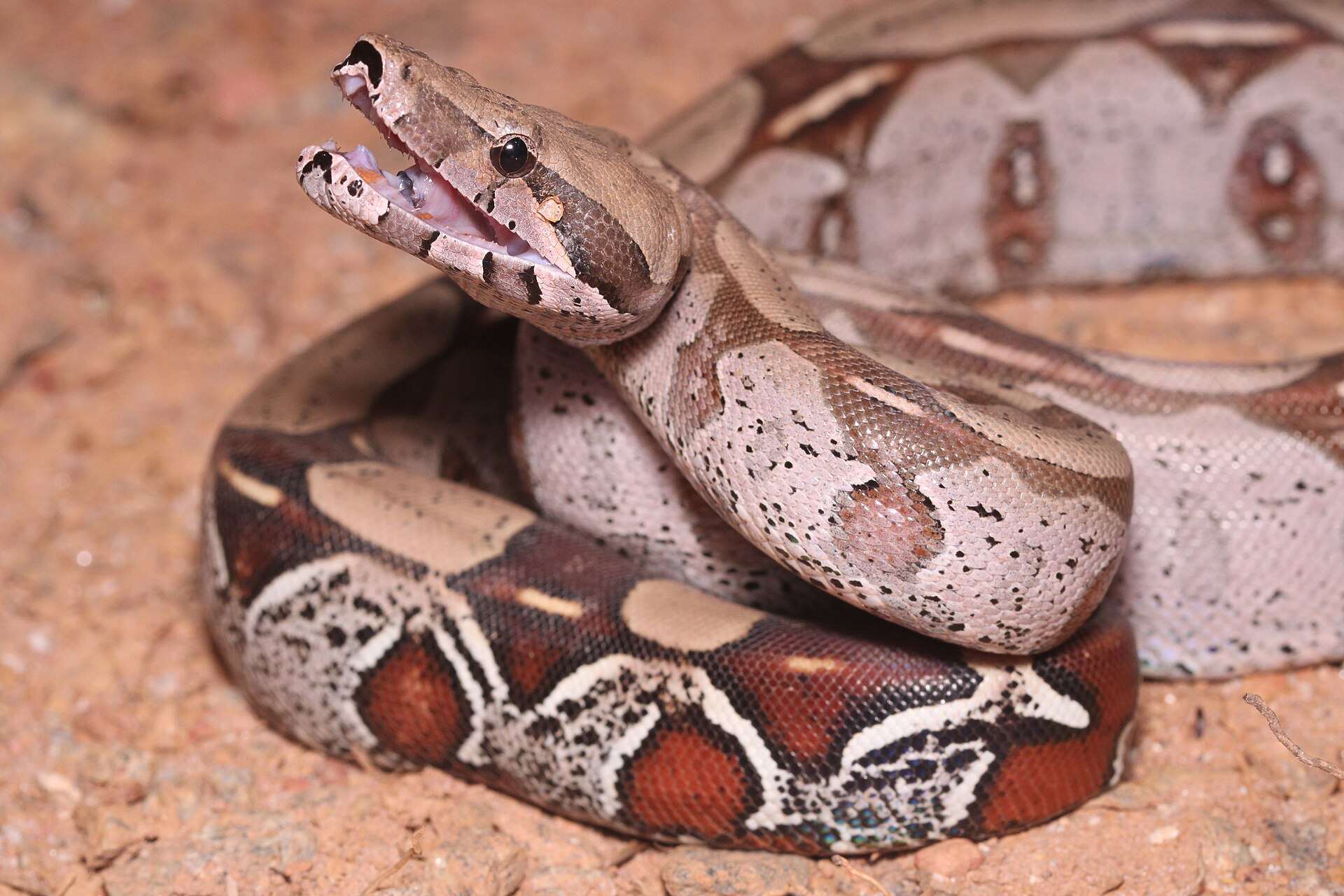
A large, heavy-bodied constrictor of South America, light brown with dark saddle-like markings that turn red and black on the tail. It is harmless to people and is widely kept as a pet.

Is it dangerous?
No. It has no venom, but it may hiss and bite if cornered or handled, and a large boa is very strong. Leave wild boas alone.
Harmless to people, but it may bite if handled. Treat any snake you can’t identify as venomous.
Snakebite first aidAt a glance
- Length
- 2.5–4.45 m
- Active
- At night
- Found in
- South America
- Venom
- None
- Young
- Live young
- Habitat
- Rainforest, Dry forest, Savanna and grassland
- Diet
- Rodents, Birds, Lizards
- Lifespan
- 20–30 years in captivity, sometimes up to 40
Length shows a typical adult, then the largest recorded.
IUCN Red List status: Least Concern
Country guideSnakes of Brazil
GuidesBoa constrictor care
True size
Painted coral snakeMedically significant
0.74 m at most
About half the height of a 1.7 m adult.
Usual range 0.52–0.74 m, the bar on the ruler.
South American rattlesnakeMedically significant
1.47 m at most
About three quarters of the height of a 1.7 m adult.
Usual range 1.1–1.47 m, the bar on the ruler.
JararacaMedically significant
1.6 m at most
About as long as a 1.7 m adult is tall.
Usual range 1.06–1.6 m, the bar on the ruler.
Banded kraitMedically significant
2.25 m at most
About 1.5 times the height of a 1.7 m adult.
Usual range 1.35–2.25 m, the bar on the ruler.
TerciopeloMedically significant
2.5 m at most
About 1.5 times the height of a 1.7 m adult.
Usual range 1.5–2.5 m, the bar on the ruler.
Boa constrictorNon-venomous
4.45 m at most
About 2.5 times the height of a 1.7 m adult.
Usual range 2.5–4.45 m, the bar on the ruler.
Black mambaMedically significant
4.5 m at most
About 2.5 times the height of a 1.7 m adult.
Usual range 2.5–4.5 m, the bar on the ruler.
Green anacondaNon-venomous
5.21 m at most
About 3 times the height of a 1.7 m adult.
Usual range 3.1–5.21 m, the bar on the ruler.
Each snake is drawn at the longest length in its profile, on the same scale as the adult. Length is to scale; thickness is not.
Identification
The boa constrictor is a large, heavy-bodied snake with small scales on the snout, a vertical pupil and no heat-sensing pits on its lips2. It is light brown with a chain of dark brown, saddle-like markings along the back, which turn red and black on the tail2,3. Three dark stripes run along the head: one down the middle to the neck and one through each eye2,3.
Adults are generally 2–3 m long, and boas over 3.5 m are rare3,9,10. One of the largest known skins, from Brazil, measures 4.45 m, and the snake was probably about 4.55 m long with its head10. Females grow larger than males, and males have larger spurs, the tiny remains of hind legs, on each side of the vent2,3.
Distribution
The Reptile Database lists this species from Colombia, Venezuela, Guyana, Suriname, French Guiana, Peru, Bolivia, Brazil, Paraguay and Argentina1. The Reptiles of Ecuador project also records it in Ecuador’s Amazon lowlands and in Trinidad and Tobago2. Boas from Mexico and Central America were once included in this species, but they are now treated as separate species, Boa imperator and Boa sigma, so Boa constrictor in the strict sense lives only in South America1.
The Reptile Database lists several subspecies, including the Argentine boa (B. c. occidentalis)1. Introduced boas also live outside the native range, for example in Florida in the United States1.
Habitat
The boa constrictor lives in many kinds of habitat, including rainforest edges and clearings, woodland, grassland, dry tropical forest and thorn scrub3. It is often found along streams and rivers, and also near farms and human settlements3. It mostly stays on the ground, but it can climb to perches up to 13 m high, and young boas spend more time in trees than adults2.
Behaviour
The boa constrictor is mainly active at night2. By day it usually rests coiled on the ground, in a tree or in a tree hole2. It lives alone except when breeding9. When threatened it pulls its neck into an S-shaped coil and may give a long, loud hiss2. Boas are sometimes eaten by other snakes, including green anacondas2.
Diet
Boas catch prey both by waiting in ambush and by actively searching, then wrap it in their coils and constrict it until it suffocates2. They eat lizards, birds and mammals such as rodents, armadillos, marsupials, bats and small monkeys, and they frequently take domestic dogs, cats and rabbits2. In north-eastern Brazil, the stomachs of road-killed boas held opossums, tegu lizards, rodents and a ground-dove4.
Reproduction
Breeding takes place in the local dry season, and as many as 10 males have been found tangled around a single female2. Males use their spurs during courtship2. After 5–8 months, the female gives birth to 10–64 live young; the eggs hatch inside her body2,3. Females probably do not breed every year, and often only when they are in good condition3. There is also evidence that females can occasionally produce young without mating (parthenogenesis)1.
Venom and medical significance
The boa constrictor has no venom; boas have no venom glands and no venom-injecting fangs5. It has no fangs, but it does have rows of long, backward-curving teeth3. It kills its prey by constriction, not by venom2. Anyone bitten by a large snake should have the bite checked by a doctor.
Conservation
The boa constrictor is listed as Least Concern on the IUCN Red List (published 2021)6. It is widespread and occurs in many protected areas, but some populations may be declining2. Across the Amazon, wild boas are caught for the pet trade and for their skin and meat, and several hundred live boas and skins are shipped each year from Iquitos, Peru2.
International trade is controlled under CITES Appendix II, and the Argentine boa (B. c. occidentalis) is listed in Appendix I, the strictest category7.
Similar species
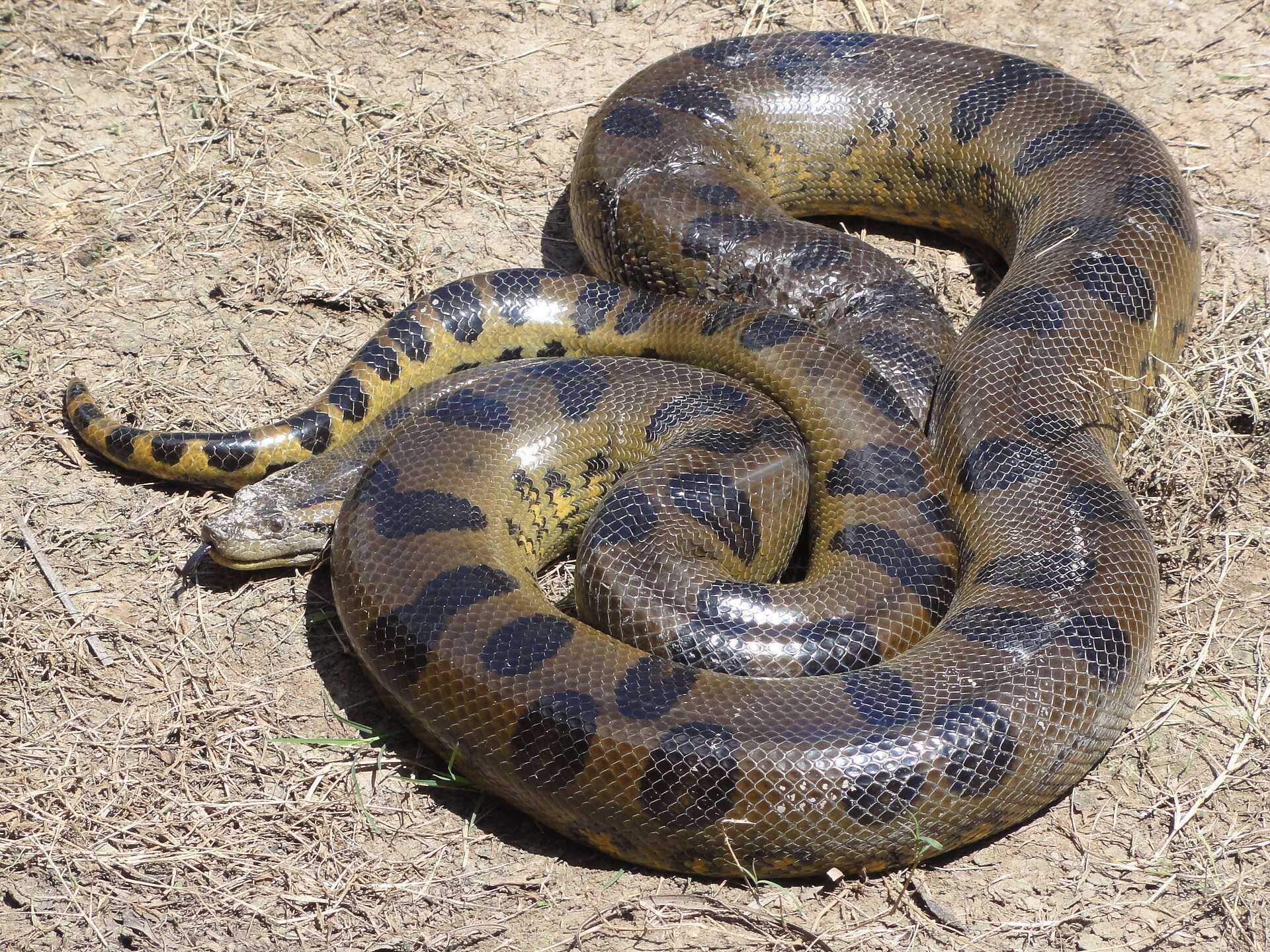
The green anaconda (Eunectes murinus) is another large, harmless constrictor of tropical South America5,8. Even experts have mixed them up: a famous 5.64 m “boa constrictor” killed in Trinidad during the Second World War was later found to be a green anaconda10. The anaconda is dark olive with round black spots and has its eyes and nostrils on top of its head8. The boa is light brown with dark saddle-like markings, three dark head stripes and a red-and-black tail2. These differences are not a safe basis for handling any snake. Keep your distance from every snake you cannot identify.
In captivity
The boa constrictor is the most common pet snake in Ecuador, and wild-caught boas are shipped to pet dealers around the world2. Owners need to plan for an animal that grows to at least 2–3 m and lives 20–30 years in captivity9, and some boas have lived up to 40 years2. The Royal Veterinary College recommends an enclosure of at least 6 × 3 × 2 feet (about 1.8 × 0.9 × 0.6 m) for an adult, with a warm-to-cool temperature gradient and branches to climb9.
Look-alikes
Don’t confuse it with…
These snakes are often mistaken for each other. Use the differences to learn, never as a reason to handle a snake.
References
- 1
Uetz, P. et al. (eds.) (2026). Boa constrictor Linnaeus, 1758. The Reptile Database. reptile-database.reptarium.cz
- 2
Duque-Torres, D., Aponte-Gutiérrez, A. & Molina-Moreno, T. (2024). Red-tailed Boa (Boa constrictor). In: Arteaga, A., Bustamante, L. & Vieira, J. (eds.) Reptiles of Ecuador: Life in the middle of the world. doi.org
- 3
Lindemann, L. (2009). Boa constrictor. Animal Diversity Web, University of Michigan Museum of Zoology. animaldiversity.org
- 4
Cabral, S. de O., Freitas, I. da S., Morlanes, V., Katzenberger, M. & Calabuig, C. (2019). Potential seed dispersers: a new facet of the ecological role of Boa constrictor constrictor Linnaeus 1758. Biota Neotropica 19(4): e20180626. doi.org
- 5
Ministério da Saúde (Brazil). Acidentes ofídicos: perguntas frequentes (boas and anacondas have no venom-injecting fangs or venom glands). gov.br
- 6
Arzamendia, V., Cisneros-Heredia, D.F., Fitzgerald, L., Flores-Villela, O., Gagliardi, G., Giraudo, A., Ines Hladki, A., Köhler, G., Lee, J., Nogueira, C. de C., Ramírez Pinilla, M., Renjifo, J., Scrocchi, G., Urbina, N., Williams, J., Wilson, L.D. & Murphy, J. (2021). Boa constrictor. The IUCN Red List of Threatened Species 2021: e.T197462A2486405. iucnredlist.org
- 7
UNEP-WCMC (2026). Boa constrictor: CITES listing (Appendix II as part of Boidae spp.; B. c. occidentalis in Appendix I). Species+. speciesplus.net
- 8
Rivas, J.A. (2000). The life history of the green anaconda (Eunectes murinus), with emphasis on its reproductive biology. PhD dissertation, University of Tennessee, Knoxville. trace.tennessee.edu
- 9
Royal Veterinary College, Beaumont Sainsbury Animal Hospital, Exotics Service (2024). Boa constrictor care (factsheet, reviewed December 2024). rvc.ac.uk
- 10
Glaw, F. & Franzen, M. (2016). On the maximum length of Boa constrictor (Serpentes, Boidae). Spixiana 39(2): 264. pfeil-verlag.de
Play
Play as the boa constrictor.
Its real pattern is a skin in Snake. Every run ends with a fact.