
Green anaconda
Eunectes murinus (Linnaeus, 1758)
Also called Anaconda, Sucuri, Common anaconda
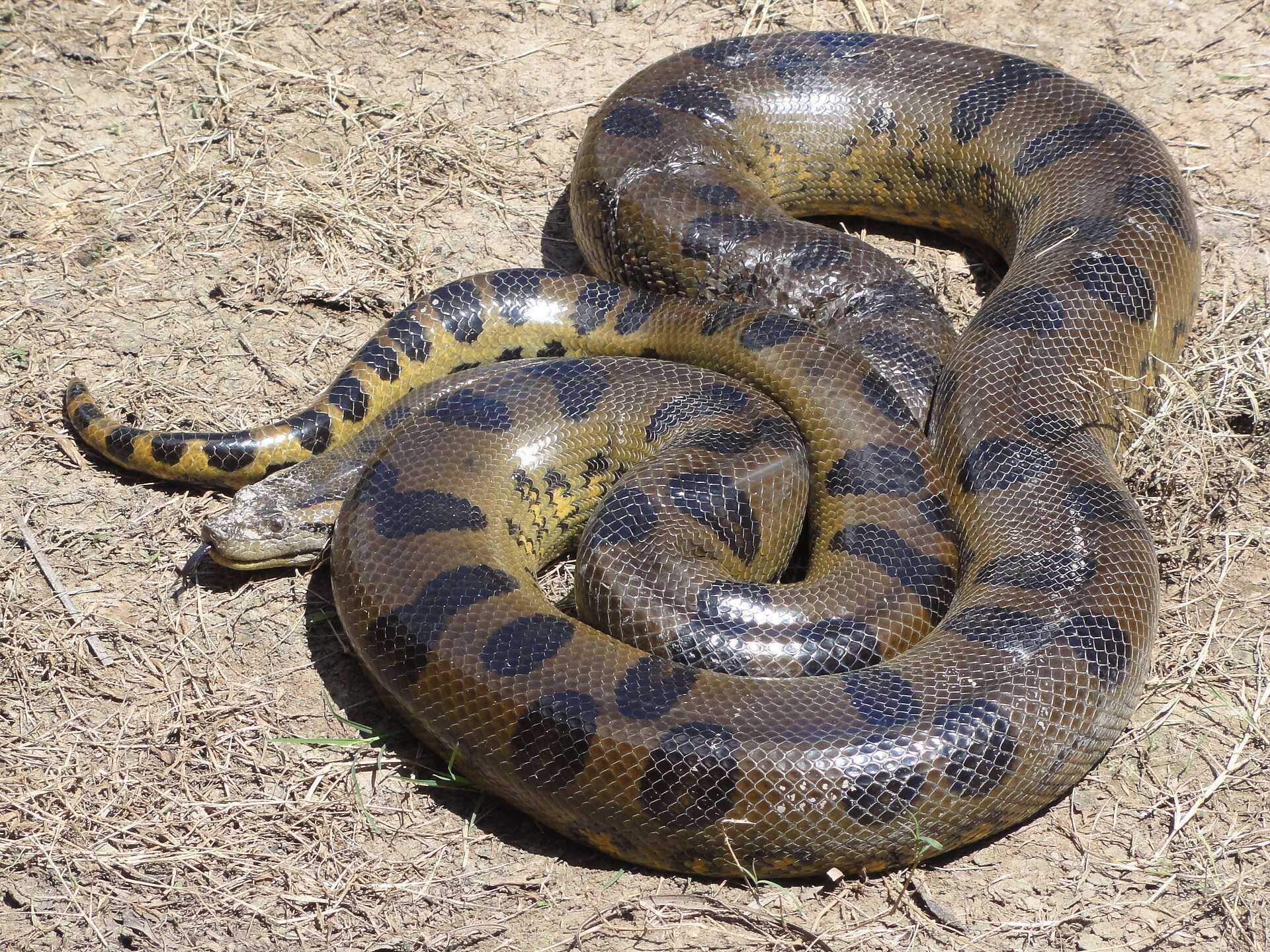
The world's heaviest snake: a thick, olive constrictor with large black spots that lives in swamps, flooded savanna and rivers of tropical South America. Its eyes and nostrils sit on top of its head.

Is it dangerous?
No. It has no venom and attacks on people are very rare, but it is a huge, strong constrictor that can bite hard. Watch it from a distance and never handle it.
Harmless to people, but it may bite if handled. Treat any snake you can’t identify as venomous.
Snakebite first aidAt a glance
- Length
- 3.1–5.21 m
- Weight
- Up to about 97.5 kg
- Active
- Day and night
- Found in
- Tropical South America
- Venom
- None
- Young
- Live young
- Habitat
- Swamps and marshes, Flooded savanna, Rivers
- Diet
- Water birds, Capybaras, Deer
- Lifespan
- Over 20 years in captivity
Length shows a typical adult, then the largest recorded.
IUCN Red List status: Least Concern
Country guideSnakes of Brazil
True size
Painted coral snakeMedically significant
0.74 m at most
About half the height of a 1.7 m adult.
Usual range 0.52–0.74 m, the bar on the ruler.
South American rattlesnakeMedically significant
1.47 m at most
About three quarters of the height of a 1.7 m adult.
Usual range 1.1–1.47 m, the bar on the ruler.
JararacaMedically significant
1.6 m at most
About as long as a 1.7 m adult is tall.
Usual range 1.06–1.6 m, the bar on the ruler.
Banded kraitMedically significant
2.25 m at most
About 1.5 times the height of a 1.7 m adult.
Usual range 1.35–2.25 m, the bar on the ruler.
TerciopeloMedically significant
2.5 m at most
About 1.5 times the height of a 1.7 m adult.
Usual range 1.5–2.5 m, the bar on the ruler.
Boa constrictorNon-venomous
4.45 m at most
About 2.5 times the height of a 1.7 m adult.
Usual range 2.5–4.45 m, the bar on the ruler.
Black mambaMedically significant
4.5 m at most
About 2.5 times the height of a 1.7 m adult.
Usual range 2.5–4.5 m, the bar on the ruler.
Green anacondaNon-venomous
5.21 m at most
About 3 times the height of a 1.7 m adult.
Usual range 3.1–5.21 m, the bar on the ruler.
Each snake is drawn at the longest length in its profile, on the same scale as the adult. Length is to scale; thickness is not.
Identification
The green anaconda is a very thick, heavy snake, and it is considered the heaviest snake species in the world2. It is dark olive with large black spots; the spots on the sides have paler centres, a pattern that blends in with water plants2. Its eyes and nostrils sit on top of the head, and males have longer spurs beside the vent than females2.
Females grow much larger than males: across 780 wild anacondas caught over seven years in the Venezuelan llanos, females averaged 3.1 m and 20 kg, and no male was longer than 3.39 m2. The largest was a female of 5.21 m and 97.5 kg2. Reports of anacondas 9–11 m long have long been debated, and none near that size was found2.
Distribution
The Reptile Database lists the green anaconda from Venezuela, Colombia, Ecuador, north-eastern Peru, northern Bolivia, eastern Paraguay, Brazil, Guyana, French Guiana and Trinidad, and a 2024 study also includes Suriname1,3. It lives in the lowlands of tropical South America east of the Andes2.
In 2024, researchers proposed that anacondas of the Orinoco basin, the Guianas, Trinidad and Amazonian Ecuador form a separate species, the northern green anaconda (Eunectes akayima), based mainly on genetic differences3. The Reptile Database does not yet accept this split: it treats E. akayima as a synonym of E. murinus, because the two cannot be told apart by their appearance1.
Habitat
The green anaconda is semi-aquatic, and much of its body shape is adapted to life in water2. In the Venezuelan llanos it lives in seasonally flooded savanna, marshes and rivers2. As the savanna dries out, anacondas shelter in drying mud, in caves in river banks, in cracks in the dry ground and under bushes beside the remaining water2.
Behaviour
Anacondas are sometimes called nocturnal, but in the llanos they were seen moving, hunting and mating at all hours, with the most activity late in the day and early in the evening2. They use quite small home ranges in each season, but make long moves between their wet-season and dry-season areas2. Pregnant females spend much of their time basking on banks, floating plants or termite mounds2.
Many young anacondas die in their first years, and adult males face a high risk of being killed by caimans2.
Diet
The green anaconda is an ambush hunter that kills its prey by constriction2. Young snakes eat mostly wading birds, then switch to larger prey as they grow2. In the Venezuelan study, about half of the prey were birds such as jacanas, ibises and whistling ducks, and the rest were large mammals and reptiles, including capybaras, white-tailed deer, spectacled caimans, river turtles and other anacondas2.
A review of published records found that birds are the prey taken most often, followed by mammals, and anacondas sometimes eat other anacondas2,4. The review found no record of an anaconda eating a human in the scientific literature4.
Reproduction
The green anaconda gives birth to live young2. In the breeding season, one female may be courted by 1 to 13 males at once, forming a “breeding ball” that can last up to four weeks2. Pregnancy lasts about 200 days, and pregnant females do not feed2.
In the Venezuelan study, litters had 5 to 74 young, with an average of about 292. Newborns were about 79 cm long and weighed about 220 g2. There is also evidence that females can occasionally produce young without mating (facultative parthenogenesis)1.
Venom and medical significance
The green anaconda has no venom; like other boas, it has no venom glands or venom-injecting fangs5. It kills its prey by constriction2. Large anacondas are very strong, and even researchers had to develop special methods to restrain and measure them2. Despite its reputation, a review of the scientific literature found no recorded case of an anaconda eating a person4. Anyone bitten should get the wound checked by a doctor.
Conservation
The green anaconda is listed as Least Concern on the IUCN Red List (published 2021)6. That assessment was made before the 2024 proposal to split the species3,6. International trade is controlled under Appendix II of CITES7.
Large females are especially important to populations: in the llanos, females over 3.4 m produced about 60% of the young born each year, so hunting the biggest snakes could cause sharp declines2.
Similar species
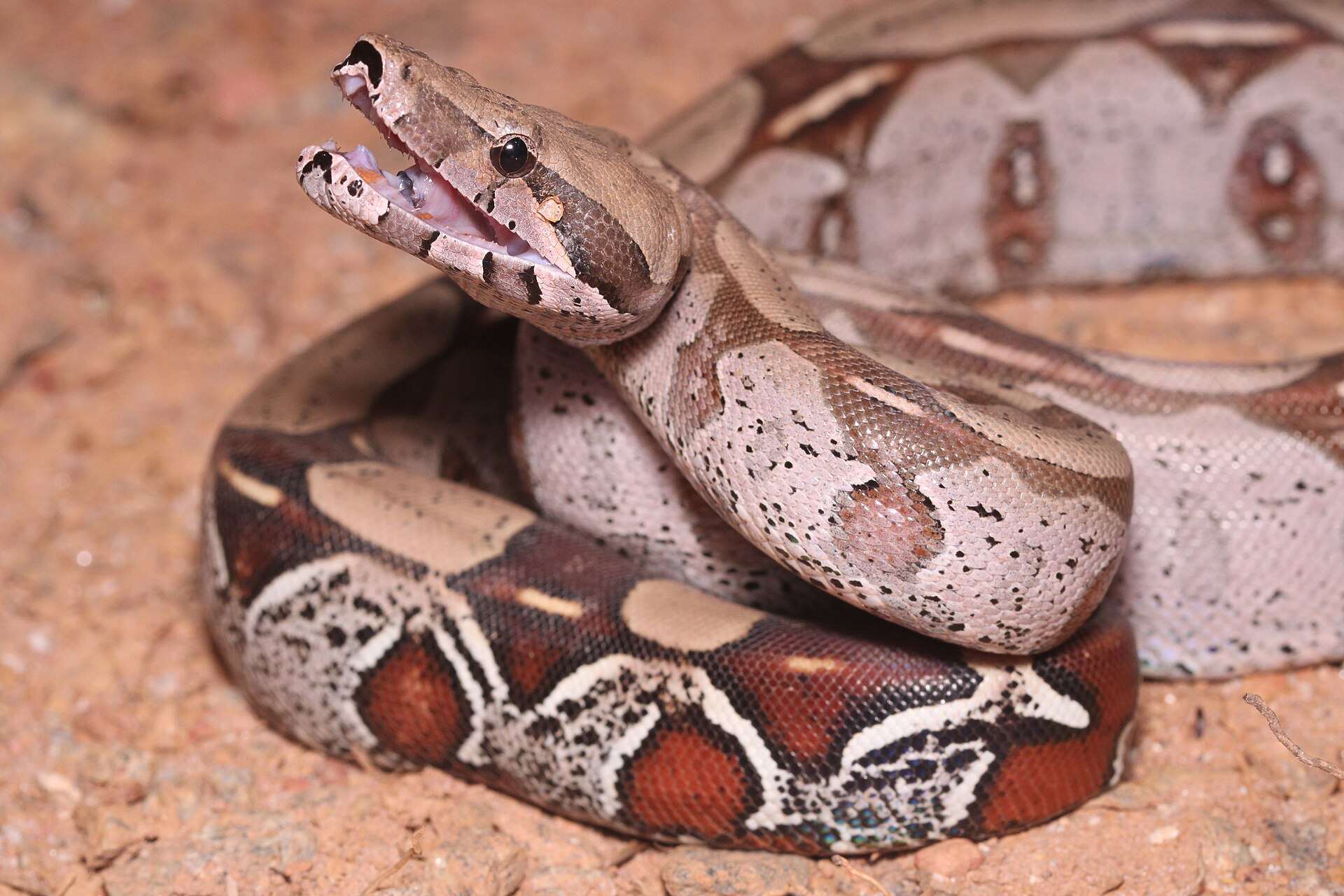
The boa constrictor (Boa constrictor) is the other large constrictor of tropical South America that people may mistake for an anaconda; both are harmless to people who leave them alone5,9. The boa is cream or brown with dark saddle-shaped bands that turn reddish towards the tail, and has three dark stripes on the head9. The anaconda is dark olive with round black spots, and its eyes and nostrils sit on top of the head2. These differences are not a safe basis for handling any snake. Keep your distance from every snake you cannot identify.
In captivity
The green anaconda is not a suitable pet: it grows very large and is so strong that even researchers needed special methods to handle it2. In captivity, anacondas have been reported to live more than 20 years2. In the United States it has been listed as injurious wildlife since 2015, so live animals cannot be imported without a special permit8. International trade needs CITES permits7.
Look-alikes
Don’t confuse it with…
These snakes are often mistaken for each other. Use the differences to learn, never as a reason to handle a snake.
References
- 1
Uetz, P. et al. (eds.) (2026). Eunectes murinus (Linnaeus, 1758). The Reptile Database. reptile-database.reptarium.cz
- 2
Rivas, J.A. (2000). The life history of the green anaconda (Eunectes murinus), with emphasis on its reproductive biology. PhD dissertation, University of Tennessee, Knoxville. trace.tennessee.edu
- 3
Rivas, J.A., Terra, J.S., Roosen, M., Champagne, P.S., Leite-Pitman, R., De La Quintana, P., Mancuso, M., Pacheco, L.F., Burghardt, G.M., Vonk, F.J., García-Pérez, J.E., Fry, B.G. & Corey-Rivas, S. (2024). Description of the Northern Green Anaconda (Eunectes akayima sp. nov. Serpentes; Boidae): What Is in a Name? Diversity 16(7): 418. doi.org
- 4
Thomas, O. & Allain, S.J.R. (2021). Review of prey taken by anacondas (Squamata, Boidae: Eunectes). Reptiles & Amphibians 28(2): 329–334. doi.org
- 5
Ministério da Saúde (Brazil). Acidentes ofídicos: perguntas frequentes (boas and anacondas have no venom-injecting fangs or venom glands). gov.br
- 6
Calderón, M., Ortega, A., Scott, N., Cacciali, P., Nogueira, C. de C., Gagliardi, G., Catenazzi, A., Cisneros-Heredia, D.F., Hoogmoed, M.S., Schargel, W., Rivas, G. & Murphy, J. (2021). Eunectes murinus. The IUCN Red List of Threatened Species 2021: e.T44580041A44580052. iucnredlist.org
- 7
UNEP-WCMC (2026). Eunectes murinus: CITES listing (Appendix II, as part of Boidae spp.). Species+. speciesplus.net
- 8
U.S. Fish and Wildlife Service (2015). Injurious Wildlife Species; Listing Three Anaconda Species and One Python Species as Injurious Reptiles; Final Rule. Federal Register 80(46): 12702–12745. govinfo.gov
- 9
Lindemann, L. (2009). Boa constrictor. Animal Diversity Web, University of Michigan Museum of Zoology. animaldiversity.org
Play
Play as the green anaconda.
Its real pattern is a skin in Snake. Every run ends with a fact.