
Jararaca
Bothrops jararaca (Wied-Neuwied, 1824)
Also called Brazilian lancehead, Yarará lancehead, Jararaca-verdadeira
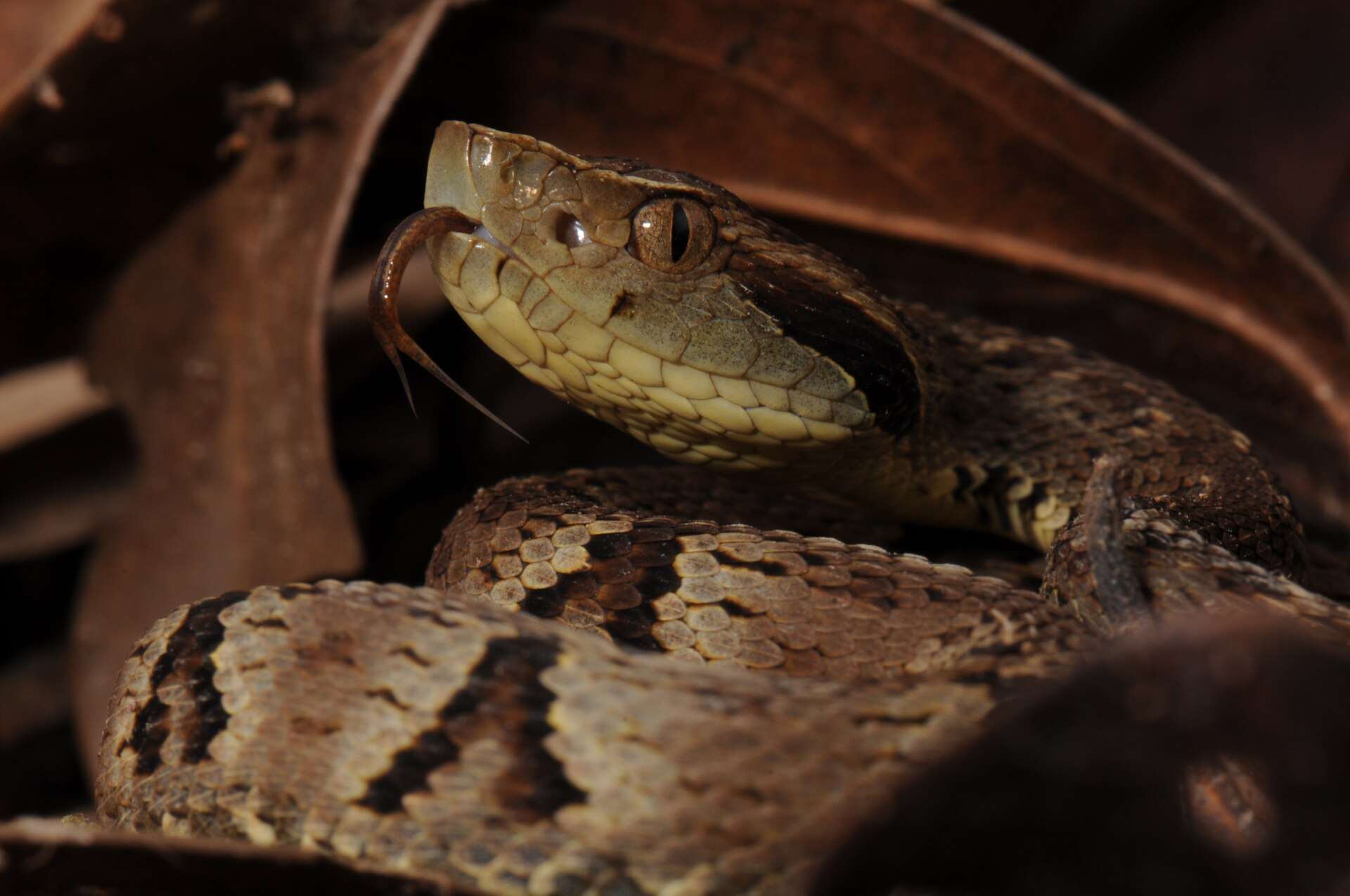
A brown or greyish lancehead of Brazil's Atlantic Forest, with dark triangular marks along its sides and a dark stripe behind each eye. It is one of the most important venomous snakes in southern and south-eastern Brazil.

Is it dangerous?
Yes. Its venom causes painful swelling, bleeding and tissue damage, and it is a major cause of snakebite in Brazil. Anyone bitten should go to hospital immediately.
Do not approach. If someone is bitten, go to a hospital now.
At a glance
- Length
- 1.06–1.6 m
- Active
- At night
- Found in
- Southern and south-eastern Brazil
- Venom
- Haemotoxic and cytotoxic
- Young
- Live young
- Habitat
- Atlantic Forest, Forest edges, Scrub
- Diet
- Rodents, Frogs, Birds
Length shows a typical adult, then the largest recorded.
IUCN Red List status: Least Concern
Country guideSnakes of Brazil
True size
Painted coral snakeMedically significant
0.74 m at most
About half the height of a 1.7 m adult.
Usual range 0.52–0.74 m, the bar on the ruler.
CopperheadMedically significant
1.35 m at most
About three quarters of the height of a 1.7 m adult.
Usual range 0.75–1.35 m, the bar on the ruler.
South American rattlesnakeMedically significant
1.47 m at most
About three quarters of the height of a 1.7 m adult.
Usual range 1.1–1.47 m, the bar on the ruler.
JararacaMedically significant
1.6 m at most
About as long as a 1.7 m adult is tall.
Usual range 1.06–1.6 m, the bar on the ruler.
CottonmouthMedically significant
1.88 m at most
About as long as a 1.7 m adult is tall.
Usual range 0.9–1.88 m, the bar on the ruler.
TerciopeloMedically significant
2.5 m at most
About 1.5 times the height of a 1.7 m adult.
Usual range 1.5–2.5 m, the bar on the ruler.
Boa constrictorNon-venomous
4.45 m at most
About 2.5 times the height of a 1.7 m adult.
Usual range 2.5–4.45 m, the bar on the ruler.
Green anacondaNon-venomous
5.21 m at most
About 3 times the height of a 1.7 m adult.
Usual range 3.1–5.21 m, the bar on the ruler.
Each snake is drawn at the longest length in its profile, on the same scale as the adult. Length is to scale; thickness is not.
Identification
The jararaca is a lancehead pit viper with a flat, sharply ridged head and a heat-sensing pit on each side of the face between the eye and the nostril3. Its colour varies with the local soil and can be olive, brown, grey, tan, yellowish or reddish3. Dark brown triangular or trapezoid marks, edged with paler colour, run along both sides of the body, and a dark stripe runs from behind the eye towards the jaw3. Young snakes often have a pale tail tip2,3.
In one museum sample, the ten largest of 29 jararacas averaged 1.06 m long2. Females grow larger than males, and individuals up to 1.6 m have been reported3.
Distribution
The jararaca lives in eastern and southern Brazil, from southern Bahia south through Espírito Santo, Rio de Janeiro, Minas Gerais, São Paulo, Paraná and Santa Catarina to Rio Grande do Sul, and west to eastern Mato Grosso1. It also occurs in north-eastern Paraguay and in Misiones province, Argentina1. It is mainly a snake of the Atlantic Forest, found from sea level to about 1,000 m2,3.
Habitat
The jararaca prefers dense evergreen and deciduous forest in the Atlantic Forest, but it is also found in scrub, upland forest and farmland near cover3. It is semi-arboreal: adults mostly stay on the ground, while young snakes are found more often on low vegetation2,3.
Behaviour
The jararaca is mostly found at night, coiled in an ambush position3. It is much less active in the colder months and most active in the warm, rainy season3. When threatened it may vibrate its tail, raise its head and neck, thrash its body or strike, and it may also hide its head or flatten its body3. Its colours blend with the ground, which helps it avoid predators such as white-eared opossums3.
Diet
The jararaca is a sit-and-wait hunter that eats a wide range of prey2. Of 45 prey items found in preserved specimens, 71% were mammals, 18% frogs, 7% birds, and the rest centipedes and lizards2. Young jararacas eat mostly frogs and lizards, which they attract by wriggling their pale tail tip like a small grub, while adults switch mainly to rodents2,3. Rodents are usually bitten, released and then tracked down, while frogs are held until they die2.
Reproduction
The jararaca gives birth to live young1. Mating takes place in April and May, but females store sperm and fertilisation happens months later, in spring3. The young are born mainly from February to April, with about 10 to 14 in a litter3. Newborns are about 24–28 cm from snout to vent and weigh 6–9 g3.
Venom and medical significance
The jararaca is highly venomous, and the WHO places it in Category 1, the highest medical importance, in Brazil4. Lanceheads cause about two-thirds of all reported snakebites in Brazil, and the jararaca was the main species in a hospital trial of lancehead bites in São Paulo7,8. A bite causes pain and swelling, sometimes with bruising and bleeding from the bite, gums, skin or urine; complications can include serious bleeding, infection, tissue death at the bite and kidney failure5. It is treated with antibothropic antivenom, given in hospital6, and in the São Paulo trial no patients died, though some developed abscesses or tissue damage8. Research on jararaca venom also led to captopril, the first drug of its kind to block the enzyme ACE, now used worldwide to treat high blood pressure9. Anyone bitten should go to hospital immediately.
Conservation
The jararaca is listed as Least Concern on the IUCN Red List (published 2019)10. It is abundant in much of its range, and its habitats include farmland, which is one reason people meet it often3. Much of its Atlantic Forest home has been broken up into fragments3.
Similar species
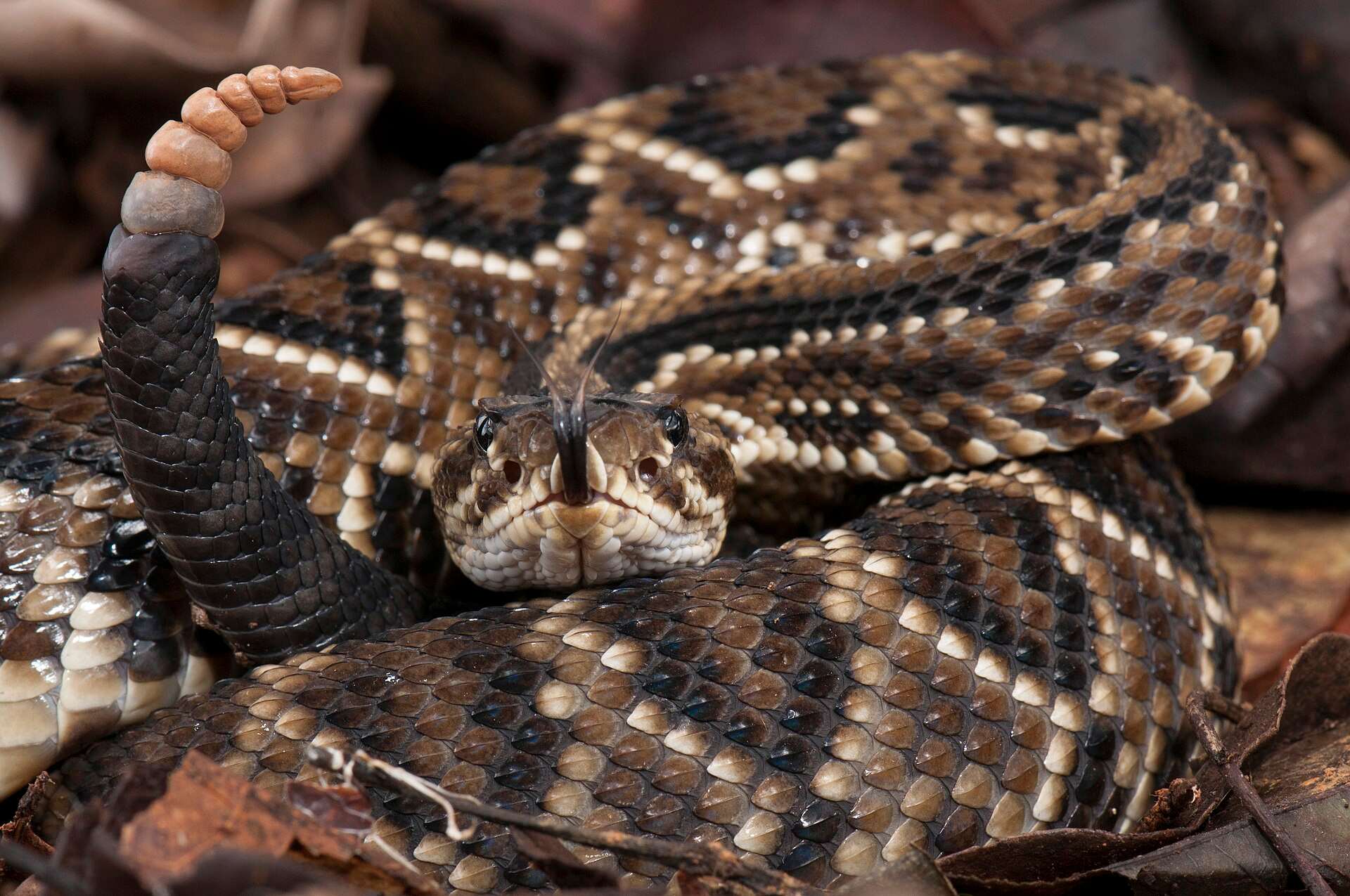
In Brazil, the South American rattlesnake (Crotalus durissus) is also a dangerous pit viper, but it has a rattle on its tail11. Rattles can break off or be lost, however12. The jararaca is smaller and lighter than the jararacuçu (Bothrops jararacussu), and it differs from the Brazilian lancehead (Bothrops moojeni) by being smaller, having a wider stripe behind the eye and lacking a wavy mark on the nape3. These differences are not a safe basis for handling any snake. Keep your distance from every snake you cannot identify.
In captivity
The jararaca is a dangerously venomous snake and is not suitable as a pet. In Brazil, keeping venomous snakes is allowed only in research centres or for the pharmaceutical industry12. At the Instituto Butantan, jararacas are kept to supply venom for antivenom production, and each produces an average of about 83 mg of dried venom13.
Look-alikes
Don’t confuse it with…
These snakes are often mistaken for each other. Use the differences to learn, never as a reason to handle a snake.
References
- 1
Uetz, P. et al. (eds.) (2026). Bothrops jararaca (Wied-Neuwied, 1824). The Reptile Database. reptile-database.reptarium.cz
- 2
Martins, M., Marques, O.A.V. & Sazima, I. (2002). Ecological and phylogenetic correlates of feeding habits in Neotropical pitvipers of the genus Bothrops. In: Schuett, G.W., Höggren, M., Douglas, M.E. & Greene, H.W. (eds.) Biology of the Vipers, pp. 307–328. Eagle Mountain Publishing, Utah. labvert.ib.usp.br
- 3
Murphy, A. (2013). Bothrops jararaca. Animal Diversity Web, University of Michigan Museum of Zoology. animaldiversity.org
- 4
World Health Organization (2017). Guidelines for the production, control and regulation of snake antivenom immunoglobulins. WHO Technical Report Series No. 1004, Annex 5, Appendix 1: Worldwide distribution of medically important venomous snakes. cdn.who.int
- 5
Ministério da Saúde (Brazil). Acidentes ofídicos: sintomas. gov.br
- 6
Ministério da Saúde (Brazil). Acidentes ofídicos: tratamento (antibothropic antivenom, SABr). gov.br
- 7
Ministério da Saúde, Secretaria de Vigilância em Saúde e Ambiente (2024). Epidemiologia dos acidentes ofídicos no Brasil em 2023. Boletim Epidemiológico 55(15). gov.br
- 8
Cardoso, J.L., Fan, H.W., França, F.O., Jorge, M.T., Leite, R.P., Nishioka, S.A. et al. (1993). Randomized comparative trial of three antivenoms in the treatment of envenoming by lance-headed vipers (Bothrops jararaca) in São Paulo, Brazil. Quarterly Journal of Medicine 86(5): 315–325. pubmed.ncbi.nlm.nih.gov
- 9
Camargo, A.C., Ianzer, D., Guerreiro, J.R. & Serrano, S.M. (2012). Bradykinin-potentiating peptides: beyond captopril. Toxicon 59(4): 516–523. doi.org
- 10
Cacciali, P., Carreira, S., Kacoliris, F., Montero, R., Pelegrin, N. & Scott, N. (2019). Bothrops jararaca. The IUCN Red List of Threatened Species 2019: e.T15203324A15203411. iucnredlist.org
- 11
Ministério da Saúde (Brazil). Acidentes ofídicos (overview of the four types of venomous snakebite in Brazil). gov.br
- 12
Ministério da Saúde (Brazil). Acidentes ofídicos: perguntas frequentes. gov.br
- 13
Mendes, G.F., Stuginski, D.R., Loibel, S.M.C., de Morais-Zani, K., da Rocha, M.M.T., Fernandes, W., Sant'Anna, S.S. & Grego, K.F. (2019). Factors that can influence the survival rates of coral snakes (Micrurus corallinus) for antivenom production. Journal of Animal Science 97(2): 972–980. doi.org
Play
Play as the jararaca.
Its real pattern is a skin in Snake. Every run ends with a fact.