
Care guide
Boa constrictor care
Boa constrictors grow to 2–3 m and live for 20–30 years, so owning one is a long commitment. They need a large, secure enclosure, a warm-to-cool gradient, plenty of humidity and careful feeding.
Every fact is sourced · draft, pending review by a reptile vet
At a glance
- Adult size
- Usually 2–3 m; rarely over 4 m6
- Enclosure for an adult
- At least 183 × 91 × 61 cm (6 × 3 × 2 ft)1
- Warm side
- Basking spot of up to about 32 °C1
- Cool side
- About 24 °C1
- Humidity
- 50–80%1
- Feeding an adult
- Thawed rats or rabbits no wider than the snake's mid-body, every 10–14 days2
- Lifespan in captivity
- 20–30 years1
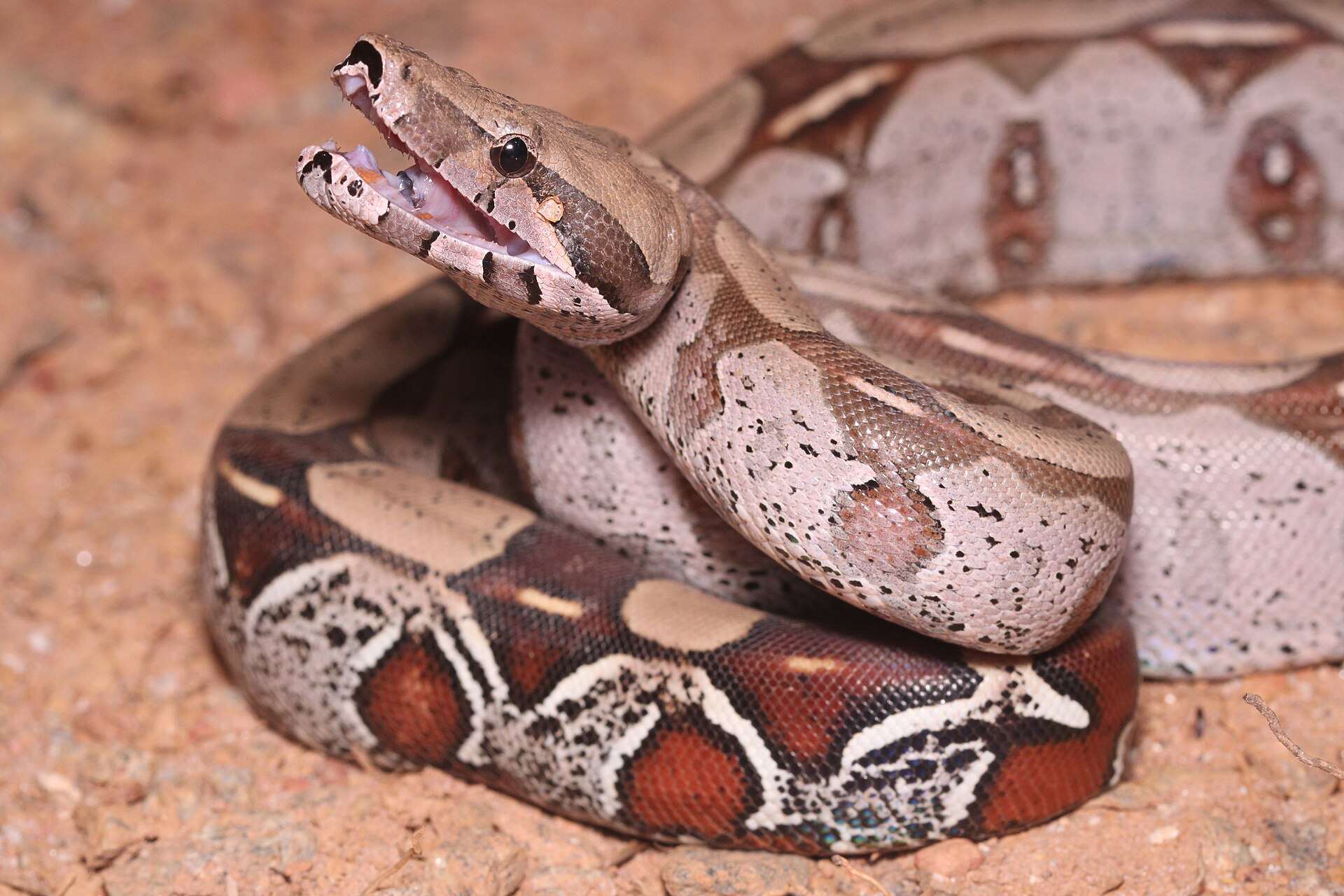
Before you get one
The Royal Veterinary College asks anyone thinking of owning a boa to weigh up its size, the space it needs, the cost and the risks, because boas grow to at least 2–3 m and live 20–30 years in captivity1. Females are usually larger than males, very few boas grow longer than 4 m, and captive boas have lived about 40 years6. The Reptile Database now limits Boa constrictor to South America and treats boas from Central America and Mexico as a separate species, Boa imperator, so ask which kind you are buying7,8. Owners sometimes release boas that have grown too big, and feral boas have become established in Florida, so never let one go10,9,7. Keeping constrictors is banned in many places: Queensland, for example, lists the boa constrictor as a prohibited invasive animal5,9. Choose a captive-bred boa, as captive-bred reptiles are less likely to bite or carry parasites, and ask the seller about inclusion body disease, because infected boas can carry the virus for months or years with few signs5,13.
Enclosure
The Royal Veterinary College’s absolute minimum for an adult is 183 × 91 × 61 cm (6 × 3 × 2 ft), and one veterinary hospital gives at least 1.8 m × 61 cm × 61 cm1,2. The MSD Veterinary Manual asks for at least 0.6 m² of floor per metre of snake, which is about 1.5 m² for a 2.5 m boa3. These minimums are shorter than many adult boas, and welfare research argues for more: a review found that even sedentary snakes use a lot of space and need to stretch out, and the UK government’s Animal Welfare Committee advises that a vivarium one snake-length long and two-thirds of a length wide is acceptable only for short-term display12,11. Boas are born 30–60 cm long and reach adult size in 3–4 years, so plan the adult enclosure from the start9. Use a well-ventilated wooden or fibreglass vivarium with hides at both ends and sturdy branches, because boas like to climb1.
Heat and light
The Royal Veterinary College recommends a basking spot of up to about 32 °C from a light that is on all day, a cool end of about 24 °C, and background heat so nights stay above about 24 °C1. Other sources differ by a few degrees: the MSD Veterinary Manual gives a preferred air range of 28–31 °C with basking spots about 5 °C warmer, and one veterinary hospital gives 27–29 °C by day, a basking spot of up to 35 °C and nights of 21–27 °C4,2. Put every heater on a thermostat and guard it, and keep heat mats to no more than 25–30% of the floor1,2. Never use “hot rocks”, which often burn larger reptiles3. A low-level UVB lamp on for 12 hours a day is recommended1,4.
Humidity and water
Sources differ widely on humidity: the Royal Veterinary College gives 50–80%, one veterinary hospital at least 50–70%, and the MSD Veterinary Manual 70–95%1,2,4. Raise the humidity slightly when a snake’s eyes turn cloudy before a shed, and give it a hide with damp sphagnum moss as a humid retreat17,2. Do not reduce ventilation to hold humidity, because damp, stale air causes skin and respiratory disease3. Provide a water container big enough for the snake to submerge in, and change the water daily1.
Feeding
Boas start on pinky mice and move up to larger prey such as rats; adults can be kept on adult rats or suitably sized rabbits1,2. One veterinary hospital advises prey no wider than the snake’s mid-body, given weekly to juveniles and every 10–14 days to adults2. Offer frozen prey thawed and warmed to about 37 °C, or freshly killed prey1,2. Never feed live rats: a veterinary manual describes a feeder rat that attacked a boa and exposed its spine14. Low temperatures, overfeeding and handling soon after a meal are common causes of regurgitation2. Feeding a large snake away from its usual enclosure, and not on loose bedding it could swallow, may reduce feeding-frenzy behaviour when you open its home enclosure16.
Handling
A boa strikes when it feels threatened, and a bite, especially from a large snake, can be painful and cause a serious wound, although it is rarely dangerous9. The RSPCA’s handling advice for pythons applies: support the whole body with one hand near the head and the other nearer the tail, never grab, and leave a snake that pulls its neck into an S shape for another time18. Wait 48 hours after a meal, avoid handling during a shed and wash the smell of prey off your hands first18,2. The UK government’s Animal Welfare Committee advises that a snake too large to be managed properly should not be kept11. Wash your hands after handling, because reptiles can carry Salmonella1.
Health and when to see a vet
Book a health check soon after you get a boa and then once a year, and keep a new snake apart from others for 3–6 months17,2,3. Inclusion body disease, caused by a reptarenavirus, should be considered in every sick boa; it cannot be cured, and it spreads through body fluids and snake mites13. See a reptile vet if you notice:
- weight loss, regurgitation, poor sheds, or neurological signs such as odd tongue flicking or failing to turn the right way up, which can be signs of inclusion body disease13;
- wheezing, difficulty breathing or discharge from the mouth, signs of respiratory disease, which is very common in boas2;
- red spots or cheesy material in the mouth, signs of mouth rot15;
- mites, which can cause serious disease and spread inclusion body disease2,13;
- loss of appetite, loose droppings, difficulty shedding or lumps2;
- burns or wounds, often from unguarded heaters or live prey14.
Questions people ask
- How big do boa constrictors get?
- Most adults are 2–3 m long, and females are usually larger than males. Very few grow longer than 4 m.
- How long do boa constrictors live?
- Usually 20–30 years in captivity, and some have lived about 40 years.
- What size enclosure does a boa constrictor need?
- The Royal Veterinary College's absolute minimum for an adult is 183 × 91 × 61 cm (6 × 3 × 2 ft). Welfare research suggests that more space is better, ideally enough for the snake to stretch out.
- Are boa constrictors dangerous?
- They are not venomous. A bite from a large boa can be painful and cause a serious wound, but it is rarely dangerous, and a large boa should be handled with care.
- How often should you feed a boa constrictor?
- One veterinary hospital advises feeding juveniles weekly and adults every 10–14 days, with prey no wider than the snake's mid-body. Overfeeding can cause regurgitation.
References
- 1
RVC Exotics Service, Beaumont Sainsbury Animal Hospital (2024). Boa constrictor care (factsheet, reviewed December 2024). Royal Veterinary College. rvc.ac.uk
- 2
Nathan, R. (DVM). Boa constrictor care (veterinary care sheet). Chicago Exotics Animal Hospital, accessed 2026. exoticpetvet.com
- 3
Divers, S.J. & Comolli, J.R. (2025). Management and husbandry of reptiles. MSD Veterinary Manual, professional version. msdvetmanual.com
- 4
Divers, S.J. & Comolli, J.R. (2025). Table: Important husbandry requirements for selected reptiles. MSD Veterinary Manual. msdvetmanual.com
- 5
Divers, S.J. (2020, updated 2026). Selecting a reptile. MSD Veterinary Manual, pet owner version. msdvetmanual.com
- 6
Lindemann, L. (2009). Boa constrictor. Animal Diversity Web, University of Michigan Museum of Zoology. animaldiversity.org
- 7
Uetz, P. et al. (eds.) (2026). Boa constrictor Linnaeus, 1758. The Reptile Database. reptile-database.reptarium.cz
- 8
Uetz, P. et al. (eds.) (2026). Boa imperator Daudin, 1803. The Reptile Database. reptile-database.reptarium.cz
- 9
Business Queensland (2026). Boa constrictor (prohibited invasive animal). Queensland Government. business.qld.gov.au
- 10
Smithsonian's National Zoo and Conservation Biology Institute. Boa constrictor (animal fact page), accessed 2026. nationalzoo.si.edu
- 11
Animal Welfare Committee (2023). Opinion on the space requirements for snakes in vivaria within pet selling establishments. Defra, UK Government. assets.publishing.service.gov.uk
- 12
Warwick, C., Arena, P. & Steedman, C. (2019). Spatial considerations for captive snakes. Journal of Veterinary Behavior 30: 37–48. doi.org
- 13
Divers, S.J. & Comolli, J.R. (2025). Viral diseases of reptiles. MSD Veterinary Manual, professional version. msdvetmanual.com
- 14
Divers, S.J. & Comolli, J.R. (2025). Environmental diseases and traumatic injuries of reptiles. MSD Veterinary Manual, professional version. msdvetmanual.com
- 15
Divers, S.J. & Comolli, J.R. (2025). Bacterial diseases of reptiles. MSD Veterinary Manual, professional version. msdvetmanual.com
- 16
Divers, S.J. (2020, updated 2026). Providing a home for a reptile. MSD Veterinary Manual, pet owner version. msdvetmanual.com
- 17
Divers, S.J. (2020, updated 2024). Routine health care of reptiles. MSD Veterinary Manual, pet owner version. msdvetmanual.com
- 18
RSPCA. Royal python care (care sheet). Royal Society for the Prevention of Cruelty to Animals, accessed 2026. rspca.org.uk