
Green vine snake
Ahaetulla nasuta (Lacépède, 1789)
Also called Long-nosed whip snake, Long-nosed tree snake
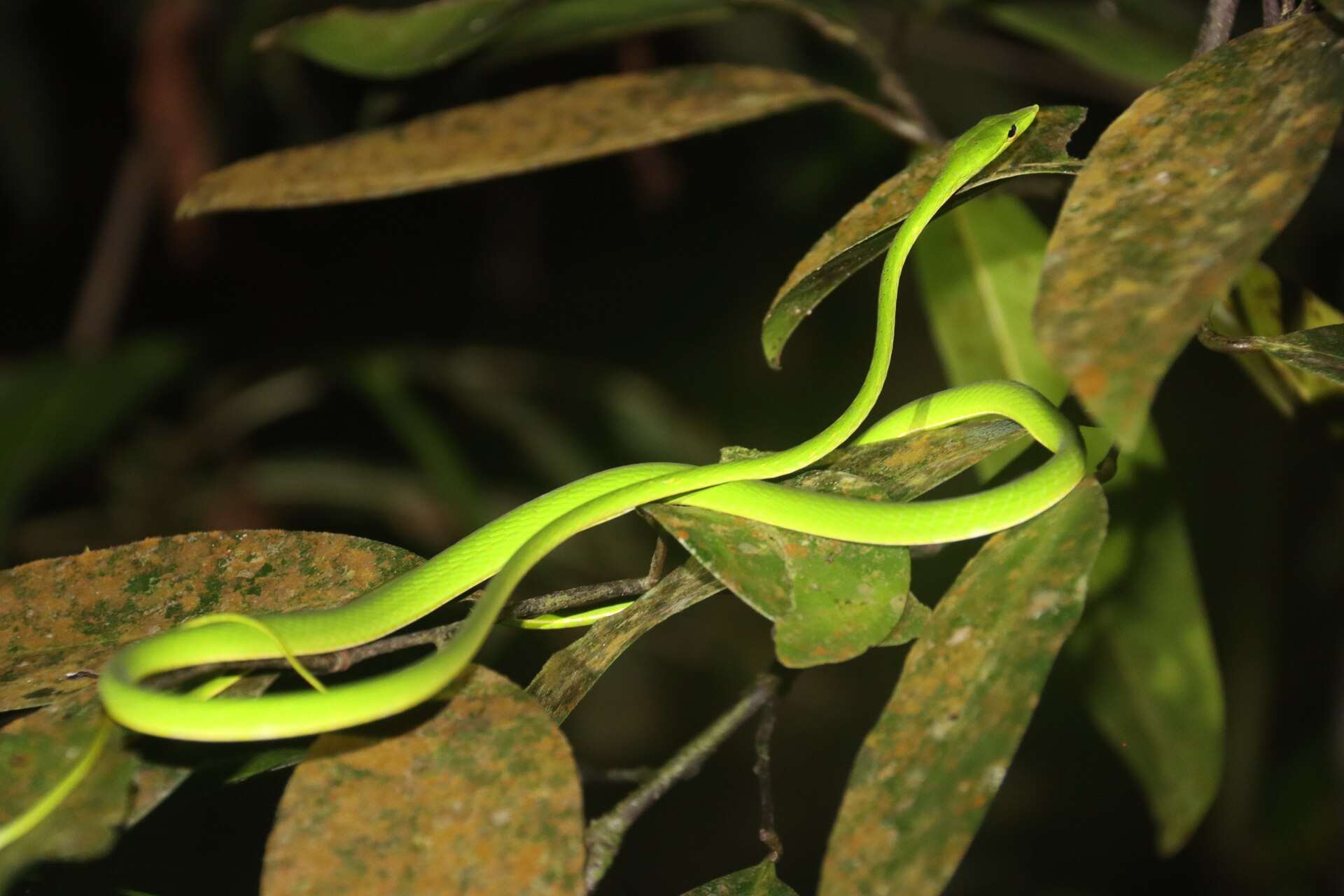
A very slender, bright green tree snake with a long pointed snout and horizontal pupils. Since a 2020 revision, the name applies only to vine snakes of Sri Lanka's wet zone.

Is it dangerous?
Mildly. It is rear-fanged, and bites usually cause only local pain and swelling. Do not handle it, and seek medical care if bitten.
Do not approach. If someone is bitten, go to a hospital now.
At a glance
- Length
- 1.0–1.5 m
- Active
- By day
- Found in
- Sri Lanka
- Venom
- Mild (rear-fanged)
- Young
- Live young
- Habitat
- Wet-zone forest, Bushes and scrub, Trees
- Diet
- Lizards, Frogs, Small birds
Length shows a typical adult, then the largest recorded.
IUCN Red List status: Least Concern
Country guideSnakes of Sri Lanka
True size
Hump-nosed viperMedically significant
0.6 m at most
About a third of the height of a 1.7 m adult.
Usual range 0.48–0.6 m, the bar on the ruler.
Common wolf snakeNon-venomous
0.92 m at most
About half the height of a 1.7 m adult.
Usual range 0.7–0.92 m, the bar on the ruler.
Green vine snakeMildly venomous
1.5 m at most
About three quarters of the height of a 1.7 m adult.
Usual range 1.0–1.5 m, the bar on the ruler.
Common kraitMedically significant
1.5 m at most
About three quarters of the height of a 1.7 m adult.
Usual range 1.0–1.5 m, the bar on the ruler.
Russell's viperMedically significant
1.68 m at most
About as long as a 1.7 m adult is tall.
Usual range 1.2–1.68 m, the bar on the ruler.
Indian cobraMedically significant
2.2 m at most
About 1.5 times the height of a 1.7 m adult.
Usual range 1.25–2.2 m, the bar on the ruler.
BoomslangMedically significant
2.3 m at most
About 1.5 times the height of a 1.7 m adult.
Usual range 1.3–2.3 m, the bar on the ruler.
Indian rat snakeNon-venomous
3 m at most
About 2 times the height of a 1.7 m adult.
Usual range 1.8–3.0 m, the bar on the ruler.
Each snake is drawn at the longest length in its profile, on the same scale as the adult. Length is to scale; thickness is not.
Identification
The green vine snake is extremely slender, with a long, sharply pointed snout that ends in a small projecting tip1,2. Its eyes have horizontal, keyhole-like pupils, a feature of the genus Ahaetulla2,3. It is usually bright green, with a thin white stripe along each side of the belly1, although some individuals are other colours2,4. When the snake is alarmed, the skin between its scales shows a black-and-white checked pattern2.
An adult female from Colombo measured 1.06 m, of which 40 cm was tail1. Older accounts, written before the 2020 revision, describe vine snakes commonly reaching about 1.5 m2.
Distribution
Since 2020, Ahaetulla nasuta has been treated as endemic to Sri Lanka, in the central and south-western wet zone1,4. For a long time the name was used for green vine snakes across India, Bangladesh, Nepal and South-East Asia4.
A study by Mallik and colleagues in 2020 showed that these snakes are a group of several species1. Indian populations are now A. borealis, A. farnsworthi, A. isabellina and A. malabarica in the Western Ghats, and A. oxyrhyncha in the lowlands1. The authors also note that Sri Lanka itself may hold more than one species1.
Habitat
In Sri Lanka this species lives in the wet, hilly zone in the centre and south-west of the island1. It is fully arboreal, spending its life in trees and bushes4. Wall described vine snakes resting on the topmost branches of low bushes and scrub, where they look just like a green twig. They also climb tall trees2.
Behaviour
Vine snakes are active by day, like the rest of their subfamily2,3. They move quickly through leaves and thin twigs, spreading their light weight over many points, but are slow on the ground2.
When threatened, a vine snake raises its front body and puffs out its neck to show the black-and-white checks between its scales. It then opens its mouth wide2. Freshly caught snakes may strike repeatedly at a person’s face2. Its Sinhala name, ahaetulla, means “eye plucker”, from an old belief that it aims for people’s eyes2.
Diet
The Reptile Database lists lizards and other vertebrates as its prey4. Older records from Sri Lanka and India also include frogs, small birds, mice and occasionally other snakes2.
Before striking, the snake draws its front body into zig-zag curves. It then darts forward, seizes its prey just behind the head and holds on until the animal’s struggles weaken2. Captive young fed readily on geckos, agamid lizards and skinks2.
Reproduction
The green vine snake gives birth to live young, usually 5–15 at a time4. The young develop inside the mother, and some are born still inside a thin membrane2. Newborn vine snakes measured in Sri Lanka were about 31–33 cm long2. In the older, wider sense of the species, young were reported to be born over a long season from about March to December2.
Venom and medical significance
The green vine snake is mildly venomous. It is rear-fanged, meaning its grooved fangs sit at the back of the upper jaw2. WHO lists the long-nosed whip snake among the colubrid snakes proven able to cause local envenoming5. Sri Lanka’s Ministry of Health lists vine snakes as mildly venomous6.
Reported bites in Sri Lanka and India caused local pain, swelling and numbness that cleared within two to three days, without wider illness2. Wall noted that symptoms in people were not usual2. Anyone bitten should still seek medical care.
Conservation
The IUCN Red List classes Ahaetulla nasuta as Least Concern (2025 assessment)7. Since the 2020 revision, this species is known only from Sri Lanka’s wet zone, a much smaller range than the old, wider species1. The authors of the revision noted that more than one species may still be hidden among Sri Lankan vine snakes1.
Similar species
In Sri Lanka, the green vine snake could be confused with the Sri Lankan green pit viper (Trimeresurus trigonocephalus), a venomous viper5,6. Pit vipers have a small sensory pit between the nostril and the eye5. The vine snake has no pit, and its pupils are horizontal3. It is also extremely slender, with a long, pointed snout and a white stripe along each side of the belly1,2.
These differences are not a safe basis for handling any snake. Since the pit viper is dangerous5,6, treat every green tree snake with caution and leave it alone.
In captivity
Vine snakes have been kept in vivaria for study since at least the 1890s. Freshly caught snakes often strike at people, and captives have eaten lizards, mice and frogs2. Because it is mildly venomous5,6 and has a small range in the wild, it is not suitable as a pet. Do not collect or handle it.
References
- 1
Mallik, A.K., Srikanthan, A.N., Pal, S.P., D'Souza, P.M., Shanker, K. & Ganesh, S.R. (2020). Disentangling vines: a study of morphological crypsis and genetic divergence in vine snakes (Squamata: Colubridae: Ahaetulla) with the description of five new species from Peninsular India. Zootaxa 4874(1): 1–62. (Ahaetulla nasuta treatment via Plazi/Zenodo: https://zenodo.org/records/4567185) doi.org
- 2
Wall, F. (1921). Ophidia Taprobanica or the Snakes of Ceylon. Colombo Museum; H.R. Cottle, Government Printer, Colombo. Account of Dryophis mycterizans (the green whip snake, in the older, broader sense of the species). archive.org
- 3
Mallik, A.K., Achyuthan, N.S., Ganesh, S.R., Pal, S.P., Vijayakumar, S.P. & Shanker, K. (2019). Discovery of a deeply divergent new lineage of vine snake (Colubridae: Ahaetuliinae: Proahaetulla gen. nov.) from the southern Western Ghats of Peninsular India with a revised key for Ahaetuliinae. PLOS ONE 14(7): e0218851. doi.org
- 4
Uetz, P. et al. (eds.) (2026). Ahaetulla nasuta (Lacépède, 1789). The Reptile Database. reptile-database.reptarium.cz
- 5
World Health Organization, Regional Office for South-East Asia (2016). Guidelines for the Management of Snakebites, 2nd edition (Warrell, D.A., ed.). New Delhi: WHO SEARO. iris.who.int
- 6
Epidemiology Unit, Ministry of Health, Sri Lanka (2018). Snake bite. Weekly Epidemiological Report 45(44). epid.gov.lk
- 7
Stuart, B.L., Grismer, L., Auliya, M., Chan-Ard, T., Srinivasulu, C., Srinivasulu, B., Mohapatra, P. & Achyuthan, N.S. (2025). Ahaetulla nasuta. The IUCN Red List of Threatened Species 2025: e.T172707A286750830. iucnredlist.org
Play
Play as the green vine snake.
Its real pattern is a skin in Snake. Every run ends with a fact.