
Brown house snake
Boaedon capensis Duméril, Bibron & Duméril, 1854
Also called Common house snake, Cape house snake, Bruin huisslang
A harmless brown snake with two pale lines on each side of its head. It hunts rodents and lizards at night and is common in gardens and around houses in southern Africa.

Is it dangerous?
No. It has no venom and is harmless to people, though it may bite if picked up. It is a common rodent-eater around homes in southern Africa.
Harmless to people, but it may bite if handled. Treat any snake you can’t identify as venomous.
Snakebite first aidAt a glance
- Length
- 0.6–1.5 m
- Active
- At night
- Found in
- Southern Africa
- Venom
- None
- Young
- Lays eggs
- Habitat
- Gardens and suburbs, Houses and outbuildings, Most natural habitats
- Diet
- Rodents, Lizards, Birds
Length shows a typical adult, then the largest recorded.
IUCN Red List status: Least Concern
Country guideSnakes of South Africa
True size
Brown house snakeNon-venomous
1.5 m at most
About three quarters of the height of a 1.7 m adult.
Usual range 0.6–1.5 m, the bar on the ruler.
Gaboon viperMedically significant
1.75 m at most
About as long as a 1.7 m adult is tall.
Usual range 1.0–1.75 m, the bar on the ruler.
Mozambique spitting cobraMedically significant
1.8 m at most
About as long as a 1.7 m adult is tall.
Usual range 1.2–1.8 m, the bar on the ruler.
Puff adderMedically significant
1.9 m at most
About as long as a 1.7 m adult is tall.
Usual range 0.8–1.9 m, the bar on the ruler.
Black-necked spitting cobraMedically significant
2.2 m at most
About 1.5 times the height of a 1.7 m adult.
Usual range 1.25–2.2 m, the bar on the ruler.
BoomslangMedically significant
2.3 m at most
About 1.5 times the height of a 1.7 m adult.
Usual range 1.3–2.3 m, the bar on the ruler.
Cape cobraMedically significant
2.3 m at most
About 1.5 times the height of a 1.7 m adult.
Usual range 1.2–2.3 m, the bar on the ruler.
Black mambaMedically significant
4.5 m at most
About 2.5 times the height of a 1.7 m adult.
Usual range 2.5–4.5 m, the bar on the ruler.
Each snake is drawn at the longest length in its profile, on the same scale as the adult. Length is to scale; thickness is not.
Identification
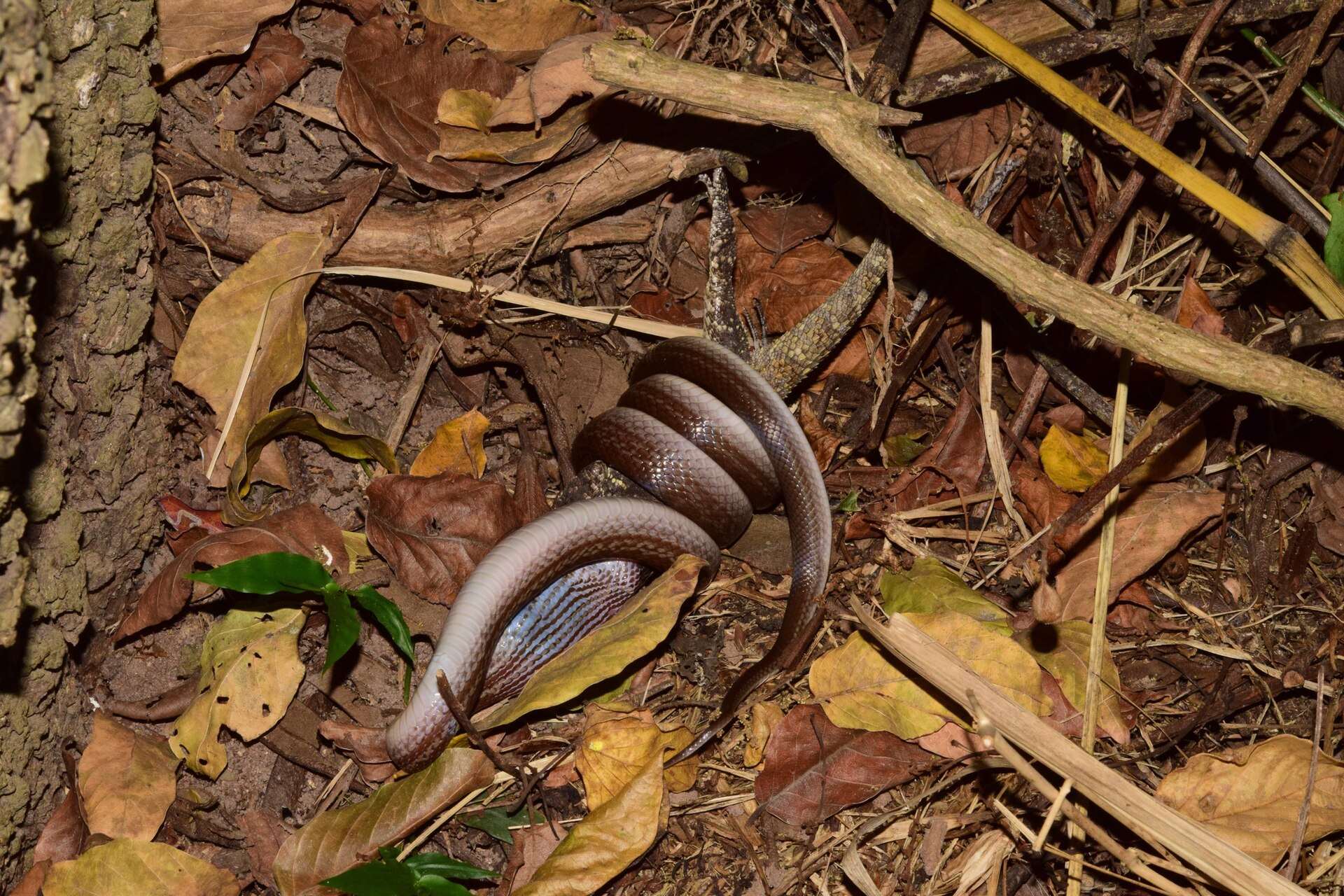
The brown house snake is a harmless snake that is usually a plain shade of brown3,4. Colours range from reddish-brown and chocolate to pinkish, dark olive or almost black, especially in old snakes, and some have reddish blotches or white mottling on the neck3,4. The belly is pale and pearly3. Its best field mark is a pair of pale lines on each side of the head: one runs from the nose over the eye to the back of the head, and the other from behind the eye to the angle of the jaw3,4. Young snakes may have faint spots or mottling4.
Size varies from place to place: adults in Gauteng average around 50–60 cm, but snakes from coastal KwaZulu-Natal often exceed 1 m, and the longest measured was 1.5 m5.
Distribution
The Reptile Database lists the brown house snake from South Africa, Lesotho, Eswatini, Botswana, Zimbabwe, Mozambique, Zambia and Malawi1. It is widespread in South Africa3. Its northern limits are still unsettled: a 2026 review noted that the species is currently treated as ranging north through East Africa to southern Somalia, but warned that this wide range may hide several unnamed species2. The Reptile Database also mentions older reports from Somalia, Ethiopia, Kenya and Tanzania1.
Habitat
This snake is found in almost every habitat in southern Africa, and it is particularly common in residential areas6. True to its name, it often lives in and around houses, and it is very common in suburban gardens3.
Behaviour
The brown house snake is active at night and is fairly slow-moving3. Its genus name, Boaedon, means “with teeth like a boa”2, and like a boa it kills its prey by constriction, squeezing it with its body3. It uses its teeth to hold onto prey9. It will bite if it feels threatened6. It is eaten by many predators, including file snakes, cobras, monitor lizards, button spiders, owls, snake eagles and mongooses6.
Diet
The brown house snake feeds largely on rodents and lizards3. Birds, bats and skinks are also eaten, and frogs only rarely6. A 2025 study found that preserved museum specimens contained only mammal and reptile prey, while published records and photos from citizen scientists also showed it eating amphibians and birds8. This suggests its diet is broader than museum data alone would show8.
Reproduction
The brown house snake lays eggs1. A female lays between 8 and 18 eggs in summer, and may lay more than one clutch in a season6.
Venom and medical significance
The brown house snake has no venom, and the African Snakebite Institute classes it as completely harmless3,10. It has no fangs: all its teeth are solid and similar in shape, and snakes with this kind of teeth in southern Africa are considered non-venomous9. It can still bite if handled, and a bite may bleed a little but causes no other symptoms10. Bites do happen: in South African snakebite records it was among the ten species most often named in bite incidents11. If there is any doubt about which snake caused a bite, seek medical care.
Conservation
The brown house snake is listed as Least Concern on the IUCN Red List (2021 assessment)12. It is widespread and very common, especially around homes and gardens3,6.
Similar species
Of the other house snakes in southern Africa, the aurora house snake (Lamprophis aurora) is easily told apart by the orange stripe down its back, while the olive house snake (Lamprophis inornatus) is often confused with other plain-coloured snakes7. More importantly, some venomous snakes are mistaken for harmless ones: in South African bite records, most bites by Bibron’s stiletto snake (Atractaspis bibronii) were on the fingers, probably because people misidentified it and picked it up11. The pale head stripes of the brown house snake are its most reliable field mark3,4.
These differences are not a safe basis for handling any snake. Keep your distance from every snake you cannot identify.
In captivity
The brown house snake can live a long time in captivity: one is known to have lived for 20 years6. In the wild it is a useful snake to have around, because it feeds largely on rodents near homes3.
References
- 1
Uetz, P. et al. (eds.) (2026). Boaedon capensis Duméril, Bibron & Duméril, 1854. The Reptile Database. reptile-database.reptarium.cz
- 2
Tiutenko, A. & Bates, M.F. (2026). Two centuries of confusion: the status of Boaedon fuliginosus and Boaedon capensis, and the resurrection of Boaedon unicolor (Serpentes: Lamprophiidae: Lamprophiinae: Boaedontini). Salamandra 62(1): 1–26. doi.org
- 3
African Snakebite Institute. Brown House Snake (Boaedon capensis) species account. africansnakebiteinstitute.com
- 4
African Snakebite Institute (2026). Colour variation in Brown House Snakes. africansnakebiteinstitute.com
- 5
African Snakebite Institute. Determining the sex and age of snakes. africansnakebiteinstitute.com
- 6
Iziko Museums of South Africa. Lamprophis capensis (Brown house snake). Biodiversity Explorer. biodiversityexplorer.info
- 7
Iziko Museums of South Africa. Lamprophis (house snakes). Biodiversity Explorer. biodiversityexplorer.info
- 8
Barends, J., Bassier, I., Maritz, R. & Maritz, B. (2025). Contrasting three diet datasets for the African brown house snake, Boaedon capensis. African Journal of Herpetology 74(1): 149–157. doi.org
- 9
African Snakebite Institute (2024). Teeth and fangs. africansnakebiteinstitute.com
- 10
African Snakebite Institute (2024). Snakes and the danger levels assigned to them. africansnakebiteinstitute.com
- 11
Naik, H. & Alexander, G.J. (2025). The incidence of snakebite in South Africa and the challenges associated with lack of reporting. Transactions of the Royal Society of Tropical Medicine and Hygiene 119(7): 788–795. doi.org
- 12
Alexander, G.J., Tolley, K.A., Maritz, B., Weeber, J., Conradie, W. & Pietersen, D. (2021). Boaedon capensis. The IUCN Red List of Threatened Species 2021: e.T200990551A201503751. iucnredlist.org
Play
Play as the brown house snake.
Its real pattern is a skin in Snake. Every run ends with a fact.